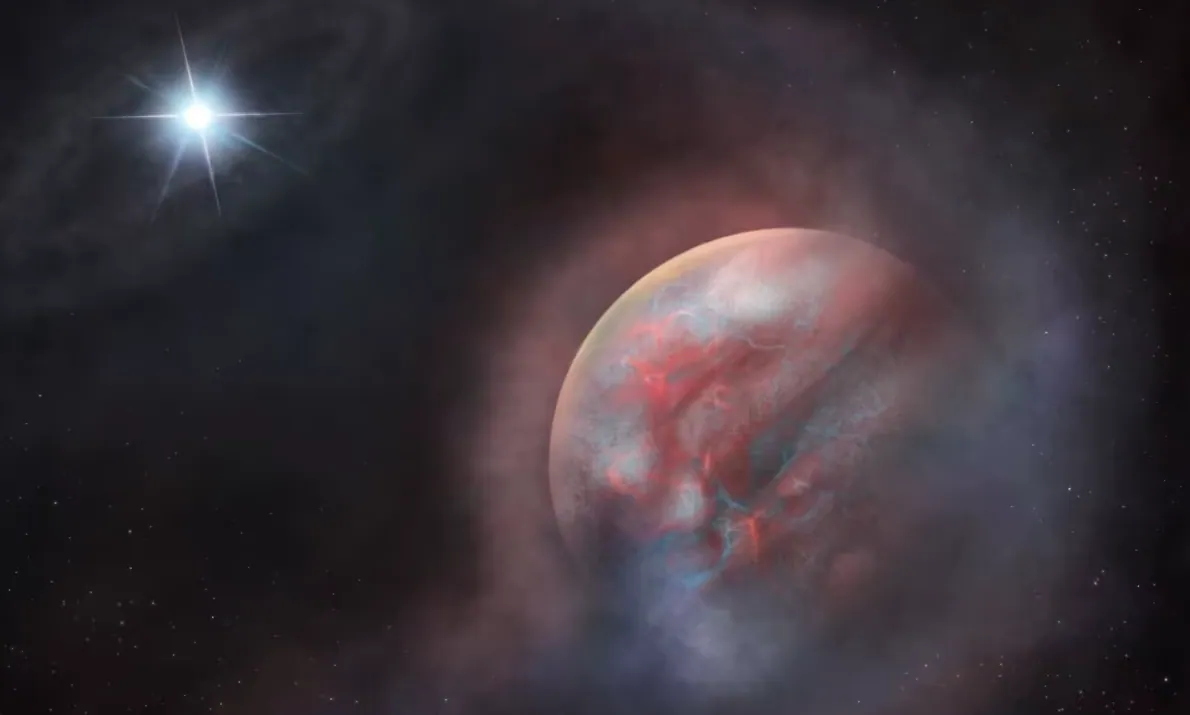
A possible gas giant orbiting white dwarf HS 0209+0832 could be a second-generation world, but researchers stress that the planet is not yet confirmed.
Astronomers have found evidence of a possible planet orbiting the white dwarf HS 0209+0832, about 270 light-years from Earth. If the interpretation holds, the object may be a gas giant formed not alongside its star but later from material expelled as the star died. The study was published Monday in Nature Astronomy.
The team analyzed observations from the Hubble Space Telescope and other instruments. It found an unusual chemical signature on the white dwarf, including niobium. The researchers believe heavy elements may have arrived with planetary material. Such elements normally sink quickly beneath a white dwarf’s surface, so their presence requires an explanation.
Additional evidence came from NASA’s TESS observations, which detected a faint brightness signal repeating about every 4.4 days. The researchers said that pattern is consistent with a large planet orbiting close to the white dwarf. Lead author Jamie Williams cautioned that the object remains a candidate, not a confirmed planet.
A white dwarf is the hot, dense core left after a star expands into a red giant and sheds its outer layers. Planets that formed with a star can sometimes survive that transformation if they orbit far enough away. The new study raises the possibility of a different kind of world, formed later from debris and gas around the stellar remnant.
The formation process is uncertain. Williams suggested that another object may have fallen into the dying star, perhaps a companion with about 20 per cent of the Sun’s mass or a brown dwarf. Such an interaction could have kept some dust and gas in a disk around the emerging white dwarf, allowing material to gather into a planet. The researchers presented this as a possible explanation, not a demonstrated sequence.
The team plans additional observations with Hubble and NASA’s Chandra X-ray Observatory and has requested time with the James Webb Space Telescope. If confirmed, the candidate would point to a new class of second-generation planets around white dwarfs. Scientists say it is too early to draw conclusions about habitability. More work is needed to verify the object and understand its environment.