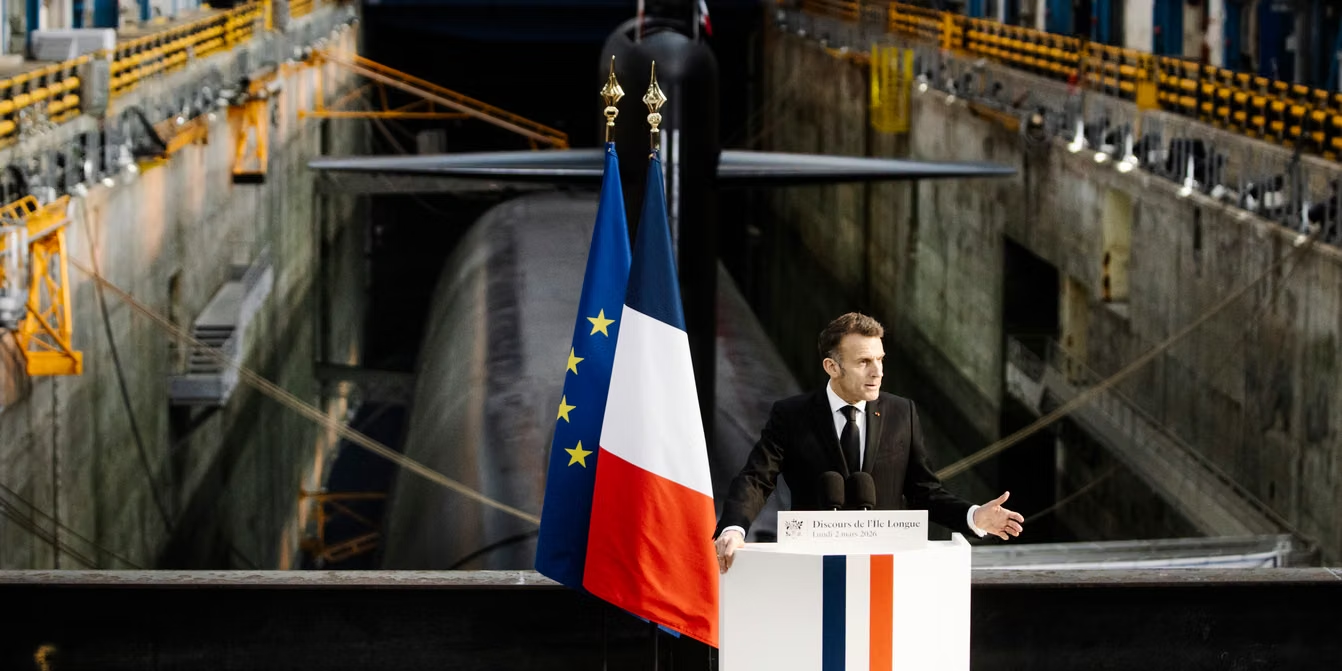
In a televised address, Macron said France will increase its stockpile – the first rise since 1992 – and will cease publishing the exact number of warheads, which currently stands at roughly 290 across its four Triomphant‑class submarines and a limited air component of Rafale fighters equipped with ASMPA‑R cruise missiles.
The president introduced the concept of “forward deterrence,” whereby nuclear‑capable Rafales could be temporarily based on the territory of willing allies and joint exercises would be conducted under a standing consultative body that allows partner governments to discuss French nuclear strategy, though the launch authority remains solely with the French president.
Macron’s proposal was met with cautious interest from Germany, Poland, Belgium, the Netherlands, Sweden, Denmark, Estonia and Greece, all of which have signaled varying degrees of willingness to engage with the French framework.
German Chancellor Friedrich Merz confirmed confidential talks with Macron and emphasized that any Franco‑German cooperation would complement, not replace, NATO’s existing nuclear sharing arrangement, noting Germany’s legal constraints under the Two‑Plus‑Four Treaty and the Nuclear Non‑Proliferation Treaty that bar it from acquiring its own warheads.
Poland’s Prime Minister Donald Tusk said Warsaw is in direct talks with Paris and aims to prepare for “the most autonomous actions possible” in the nuclear domain, language that stops short of declaring an independent weapons program but signals a desire for greater strategic independence.
The United States, while insisting that its Article 5 nuclear guarantee remains intact, has signaled a shift in burden‑sharing through its 2026 National Defense Strategy and the so‑called “NATO 3.0 review,” which calls for allies to assume primary responsibility for their own defense and has already seen the withdrawal of about 5,000 U.S. troops from Germany.
Analysts caution that France’s force of under 300 modernized warheads, even with the upcoming M51.3 missile and the planned ASN4G hypersonic missile slated for the mid‑2030s, is not sized for continent‑wide extended deterrence, and the details of how forward deployment would work remain vague.
The debate has broader implications for the Nuclear Non‑Proliferation Treaty, as European states’ public discussion of deeper nuclear cooperation could erode the long‑standing rationale that non‑nuclear allies rely on U.S. extended deterrence to forgo their own arsenals.
While no formal treaty or shared launch authority has been offered, the French initiative marks the first time European leaders have publicly contemplated a collective nuclear posture beyond the traditional U.S. umbrella, a shift that could reshape NATO dynamics and European security policy for years to come.