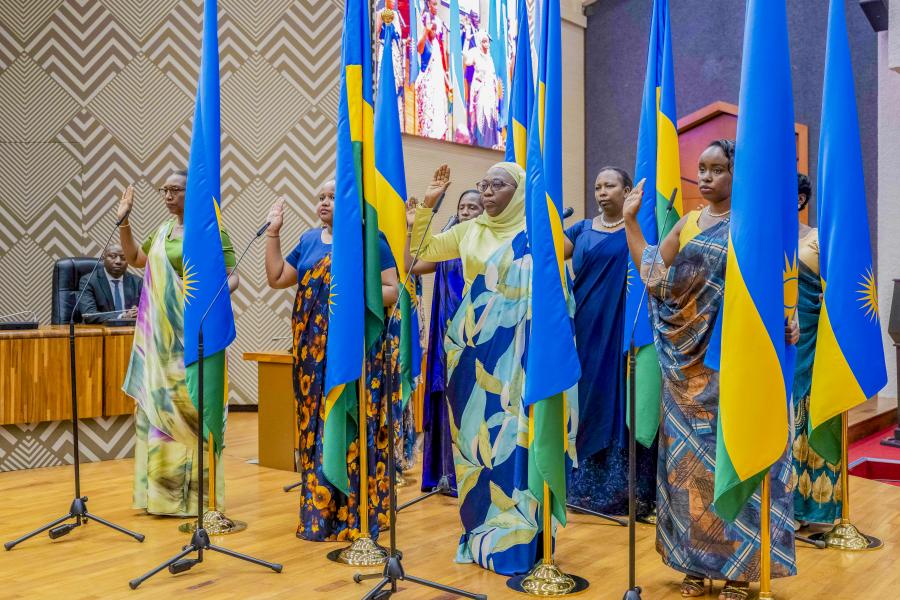
The presentation, delivered by officials at the Ministry of Gender and Family Promotion (MIGEPROF), highlighted that women dominate Rwanda’s elected legislature, filling nearly two‑thirds of the Chamber of Deputies and almost half of the Senate, while also serving as Chief Justice, Prosecutor General and governor of the central bank.
Women’s presence extends to local and executive bodies, with 46.9% of district council seats and 38.8% of cabinet ministries held by females; however, representation thins in appointed administrative tiers, with only 20% of provincial governors and 26% of permanent secretaries being women, and 36% of judges and 31% of heads of public institutions also female.
On the economic front, 55.6% of women are active in the labour force, a figure that still trails the 71% male participation rate by roughly 15 points, while financial inclusion remains high, with 96% of women reported as having access to formal financial services.
Land ownership data from the National Land Authority for 2024 shows that women own a mere 18.89% of land outright, compared with 12% owned solely by men, whereas almost half of all land (48.96%) is co‑owned by men and women, underscoring co‑ownership as the dominant form of tenure.
The gender ecosystem is anchored by four bodies: MIGEPROF, which sets policy on gender equality and anti‑GBV; the Gender Monitoring Office, which tracks mainstreaming across sectors; the National Women’s Council, which mobilises women into development programmes; and the Rwanda Women Parliamentary Forum, which lobbies for gender‑responsive legislation. These institutions operate within a dense policy stack that includes the Revised National Gender Policy (2021), Vision 2050, the 2024‑2029 National Strategy for Transformation (NST2), and tools such as gender‑responsive budgeting and the Indashyikirwa and Bandebereho initiatives aimed at shifting household dynamics.
While Rwanda’s elected offices showcase near‑parity, the briefing noted that gaps persist in technical appointments and land ownership, signalling ongoing policy priorities to deepen gender balance beyond high‑visibility roles.