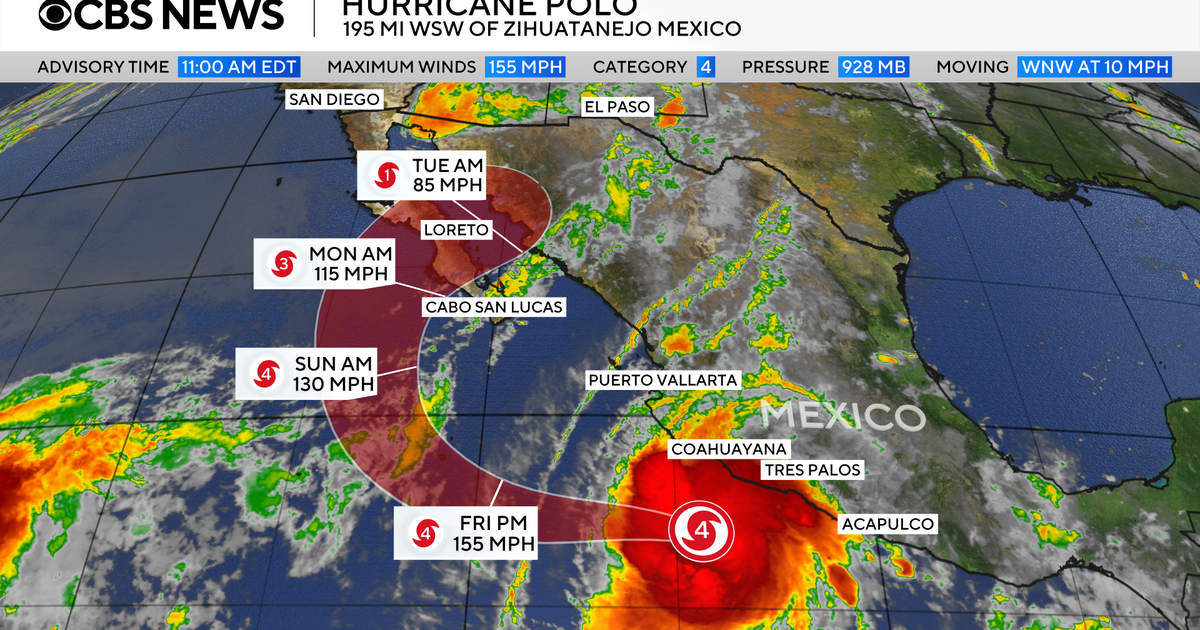
The US National Hurricane Center said Saturday night that Polo was moving northwest about 335 miles south-southwest of Cabo San Lucas at roughly 10 mph. Its maximum sustained winds were 120 mph. Hurricane-force winds extended about 40 miles from the center, while tropical-storm-force winds reached up to 160 miles.
The forecast calls for the storm to move north on Sunday, turn northeast on Monday and reach Baja California Sur before crossing northwestern mainland Mexico by Tuesday. The US State Department, citing forecast models, said Polo could weaken to Category 1 before landfall and then continue into southern Sonora. The hurricane center cautioned that it could still be a strong hurricane when it reaches Baja California Sur.
A hurricane warning covers the area from Punta Abreojos in Baja California Sur to Santa Fe, New Mexico. A hurricane watch and tropical-storm warning are also in effect for parts of the peninsula’s west coast, while a hurricane watch covers part of its east coast. The center forecasts 4 to 8 inches of rain in parts of Baja California Sur, with isolated totals of up to 10 inches, warning of life-threatening floods and mudslides, especially on steep terrain. Swells could bring dangerous surf, rip currents and coastal flooding.
Mexican authorities have ordered evacuations, opened shelters and sent military troops to areas that could be affected. Schools in Acapulco have suspended classes, while shelters remain open across Guerrero.
Polo underwent extreme rapid intensification between 21 and 22 September, gaining at least 58 mph in wind speed within 24 hours. Winds rose from 45 mph on the morning of 21 September to 150 mph around the same time the next day, and peaked at 180 mph—above the 157 mph Category 5 threshold. By Saturday morning, they had fallen to about 160 mph. Based on central pressure, Polo became the Eastern Pacific’s second-strongest hurricane on record, behind Patricia in 2015; its wind speed tied Rick in 2009 for third strongest in the region. The hurricane center said unusually strong El Niño conditions are contributing to elevated Pacific cyclone activity.