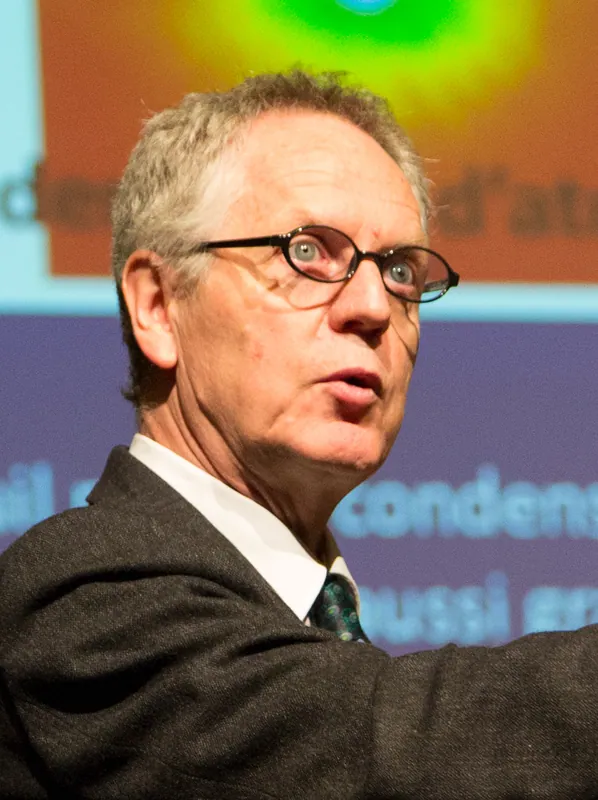
Physicist Jean Dalibard has received the Alessandro Volta Prize for research linked to laser cooling and the quantum physics of ultracold gases. The work has helped advance atomic clocks, interferometers and quantum simulators.
French physicist Jean Dalibard received the Alessandro Volta Prize in Como on October 2. The award was established by the European Physical Society and utility company Acinque. Dalibard is a professor at the Collège de France and a recipient of the French National Centre for Scientific Research (CNRS) Gold Medal. The society recognised his contributions to laser cooling, light-matter interactions and the physics of ultracold gases.
Laser cooling slows atoms to produce clouds of matter at temperatures close to absolute zero. This field of research has helped underpin several precision measurement technologies, including atomic clocks and interferometers, which can measure time and motion with great accuracy.
Nobel laureate William Phillips noted that atomic clocks are already used in many industrialised countries and help maintain precise time synchronisation. That matters for communications networks, satellites and other systems. Phillips said optical atomic clocks and interferometers could also support navigation when satellite signals are unavailable or blocked.
Another Nobel laureate, Alain Aspect, linked the importance of Dalibard’s work to quantum simulators using ultracold atoms. These systems allow researchers to study complex quantum systems. In time, that work could help with the development of new materials and medicines, although such applications remain a research prospect.
The award also gave Dalibard an opportunity to emphasise the role of scientific societies. He said professional organisations can help the public distinguish experimentally tested knowledge from individual opinion, particularly when researchers are asked to comment beyond their areas of expertise. European Physical Society president José María de Teresa said the prize also highlights the role of European physics and international cooperation in advancing science.