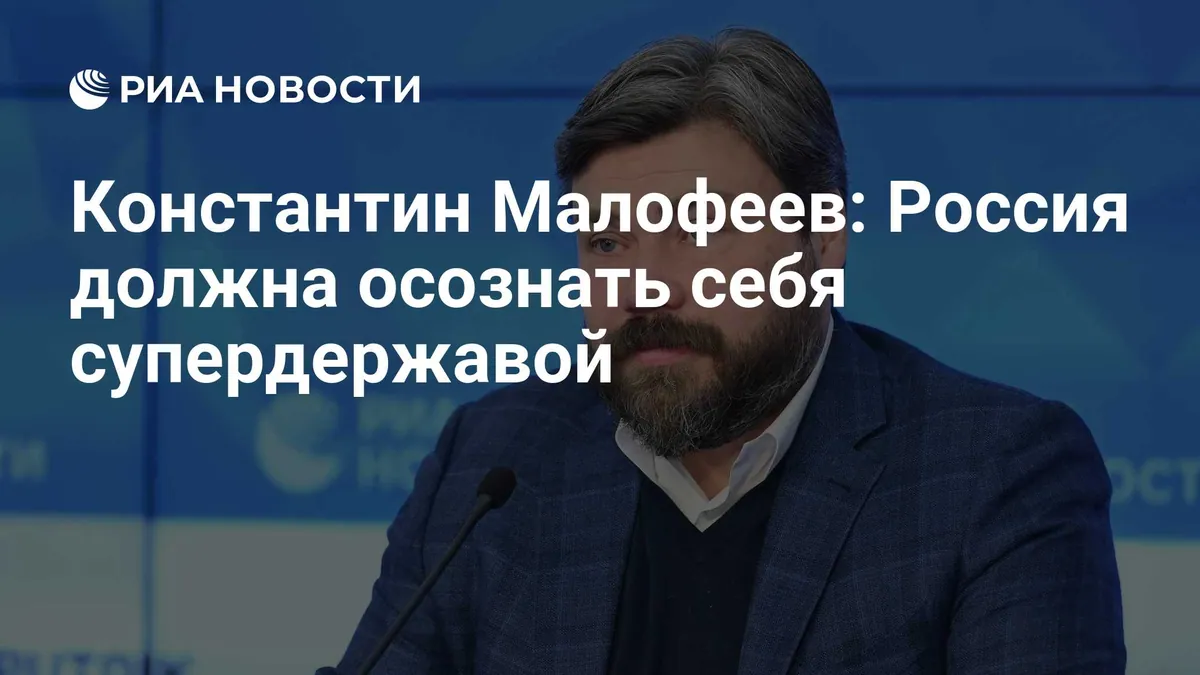
Konstantin Malofeyev, the businessman and head of the Tsargrad television channel, used an interview with RIA Novosti to describe his vision for Russia in 2050, combining conservative family policy, a stronger national identity and an expanded role for the state. Speaking with Dmitry Kiselyov, head of the Rossiya Segodnya media group, he also said Ukraine should become part of Russia and argued for using nuclear or neutron weapons to end the war. Those are the interviewee’s views, not state policy established by the interview.
Malofeyev described himself first as a Russian Orthodox Christian and said events in 2014 and the sanctions imposed on him marked a shift from investment banking toward politics and public projects. He said he spends money on Tsargrad, a private school, a research institute and support for Russian forces. He framed wealth as a responsibility before God and society, citing John Chrysostom and philanthropist Innokenty Sibiryakov.
A central subject was the “Russia 2050” report produced by the Tsargrad Institute with about 200 experts. Malofeyev argued that a long-term national vision should guide short-term government plans. He criticised official demographic targets, saying a goal of reaching a total fertility rate of 1.8 by 2036 falls short of the 2.1 level needed for population replacement.
His proposed model includes low-rise housing, multigenerational households, stronger transport links, high-speed rail and nationwide internet access. He said the country’s elite should tie its future to Russia and called for school history to become more centred on Russia. In gaming, he favoured state subsidies for domestic studios and regulation of imported titles, including restrictions on games he considers politically or morally unacceptable.
The sharpest remarks concerned Ukraine and the war. Malofeyev called Ukraine part of Russia, advocated restoring what he described as historical borders and proposed leaving western regions as a separate Ukrainian entity. He also said Russia should use its nuclear or neutron arsenal to stop the conflict. He presented this as his personal opinion and acknowledged that the decision rests with others. His claims about borders and weapons of mass destruction are political positions, not objective findings.
Malofeyev said Russians who left the country should not be barred from returning, but argued that those he believes supported Ukraine or might influence public life should face restrictions. The interview also covered state involvement in video games, subsidised mortgages for family homes and the election campaign of his wife, Maria, on the United Russia party list.
He links his call for a Russia-centred historical narrative to the idea of Moscow as a “Third Rome” and to the legacy of Byzantium. Malofeyev argued that the conventional division between world history and Russian history leaves Russia outside the main account of global events. He cited China and India as examples of countries increasingly teaching history from a national perspective. He also called for state regulation of localised foreign video games and subsidies for Russian studios. In his view, games can teach skills related to drone operation, so support should include the defence and industry ministries.
On his own trajectory, Malofeyev said he shifted from investment banking to politics and public projects after 2014. He recounted sending $1 million to a fund associated with Sevastopol official Alexei Chaly that year, saying the money was later frozen. He declined to give details about his current business, citing sanctions imposed on him and people associated with him. In the interview, he rejected wealth accumulation as an end in itself and described private money as something its holder should share.
Malofeyev said Russians who left should be allowed to return, but argued for distinguishing those who left for personal reasons from people he believes supported Ukraine. He said the latter should face severe punishment and proposed restrictions on some returnees’ access to public office, state corporations and media platforms. These remarks are his own political judgments. He also praised his wife Maria’s election campaign and backed subsidised mortgages for detached homes, which he linked to larger families.