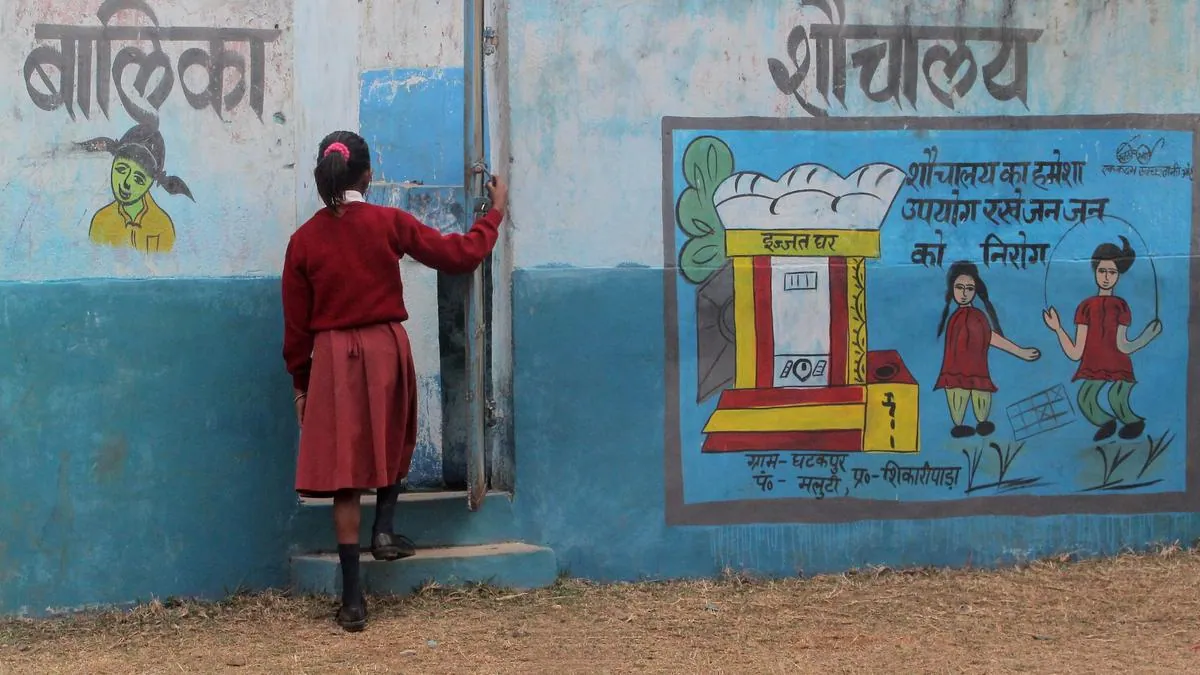
The latest figures show wider access to water and girls’ toilets, but national estimates diverge on basic sanitation and tens of thousands of schools still lack a working facility.
India has expanded access to water and toilets in schools over the past decade, but the next challenge is keeping facilities usable and measuring the gaps consistently. The Hindu’s analysis of WHO-UNICEF and UDISE+ figures points to both progress and unresolved maintenance needs.
The WHO-UNICEF Joint Monitoring Programme estimates that the share of Indian schools with basic drinking water rose from 55% in 2015 to 97% in 2025. Among 164 countries with estimates, only five improved faster. Basic sanitation coverage increased from 62% to 81%, while the share of schools with no sanitation fell from 27% to 14%.
India’s UDISE+ 2025-26 data show that 98.5% of girls’ and co-educational schools have a girls’ toilet. The article also notes that girls in Classes 9 to 12 had a lower annual dropout rate than boys, 5.7% compared with 8.3%. Separate, clean facilities matter for attendance, particularly for adolescent girls.
Availability does not always mean usability. UDISE+ records 38,994 schools where a girls’ toilet exists but is not working and another 22,366 without one. Together, that is more than 61,000 schools, about 4% of the total. Functioning girls’ toilets are reported in 72.4% of schools in Meghalaya, 74.4% in Arunachal Pradesh and 74.7% in Tripura, and in fewer than 80% in Mizoram and Nagaland. Rajasthan and Madhya Pradesh have the largest reported repair backlogs, at 7,726 and 6,188 schools.
The two data systems also differ. UDISE+ reports a working toilet in 97% of schools, while the JMP estimates basic sanitation at 81%. UDISE+ reports handwashing facilities in 96.9% of schools, but the JMP estimate for basic hygiene is about 53%, counting facilities with both soap and water. The analysis notes that UDISE+ relies on school reports rather than independent inspection, while the JMP says it lacks sufficiently current data to update India’s hygiene estimate.
The Hindu analysis argues for shifting attention from construction alone to routine maintenance. It recommends setting aside school funding for repairs, cleaning, water and soap, involving parents and school committees in regular checks, using water-saving designs in hilly states and supporting menstrual health facilities.