
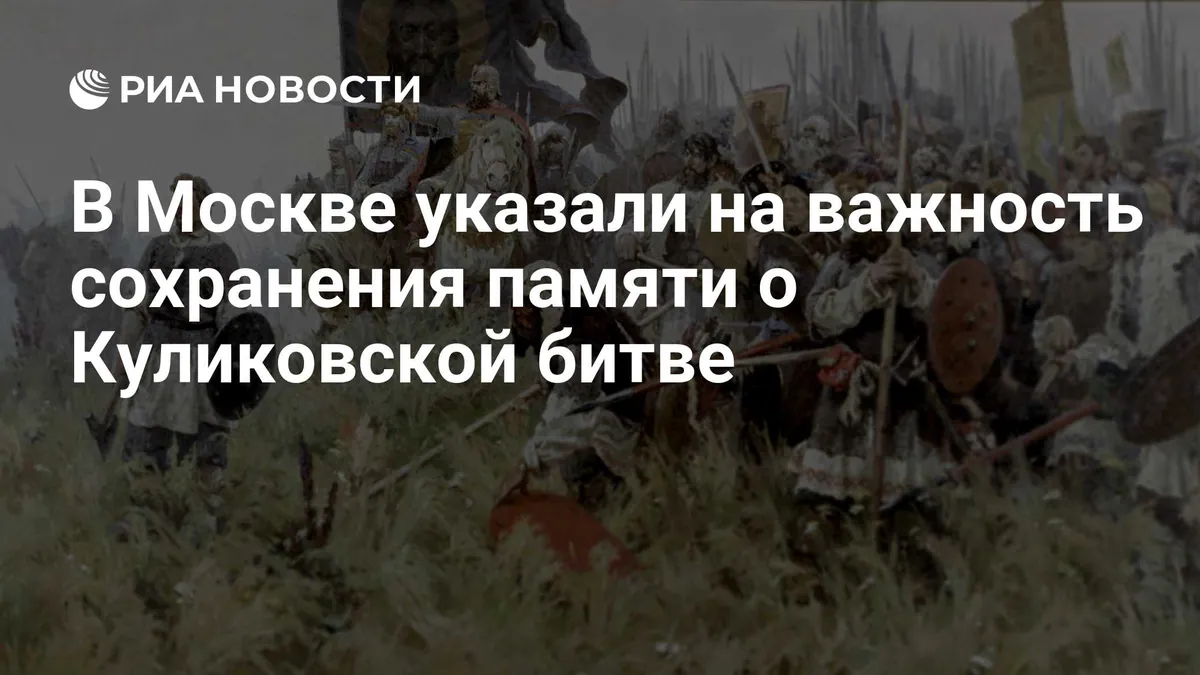
A Moscow session on October 5–6 examined interpretations of the battle, memorial sites and how historical accounts are passed to future generations.
A plenary session on the Battle of Kulikovo took place in Moscow on October 5–6 as part of the 10th All-Russian conference on theology. Participants discussed the approaching 650th anniversary and the role of historical memory. Their remarks represented views expressed at the conference, not a single consensus among historians.
Yefim Pivovar, an academician of the Russian Academy of Sciences and research director at the Russian State University for the Humanities, described the battle as a symbol of unity among principalities and peoples. Bishop Kirill (Zinkovsky) of the Moscow Theological Academy discussed its place in the idea of a multi-ethnic community. Both were presenting interpretations during the session.
Roman Sokolov, vice-rector of Herzen State Pedagogical University, said some familiar accounts of the battle and its participants are debated and reassessed by researchers. He cited 19th-century historian Nikolay Kostomarov and a claim about Dmitry Donskoy’s injury, which Sokolov said challenges the story that the prince avoided the fighting. This was the speaker’s interpretation; independent assessment would require specialist historical sources.
Speakers also discussed memorial sites and ways to communicate the battle’s history through museums, monuments, religious sites, education and culture. Vera Ivanovskaya, an associate professor at the Moscow Architectural Institute, cited the Nikolo-Ugreshsky Monastery, founded by Dmitry Donskoy in 1380. Other speakers emphasized archives, archaeology and continued research.
The session was held within the conference “Theology in the Scientific and Educational Space,” which took place in Moscow on October 5 and 6, 2026. Participants called for continued research and preservation of historical materials related to the Battle of Kulikovo.