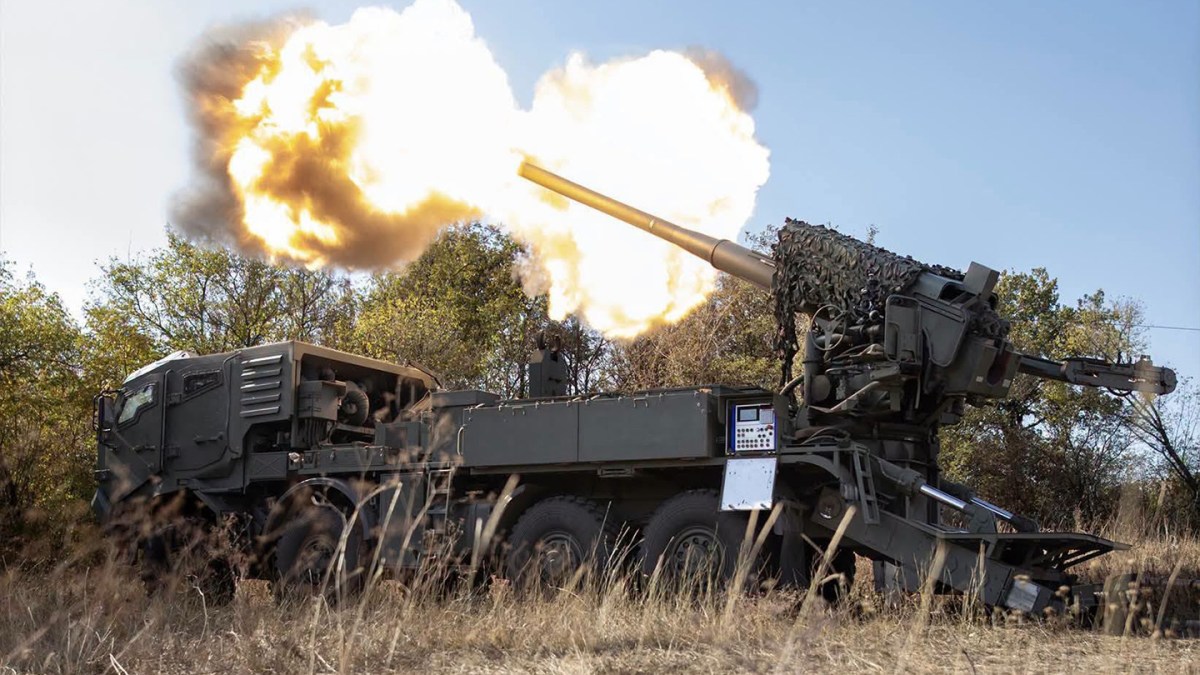
Korniienko said the old practice of massing guns to create an ‘artillery wall’ has been abandoned because each shot now instantly reveals a battery’s location to Russian drones, which can then strike the position. A typical mission now involves a handful of shells – three to five for ranging followed by a focused strike – rather than the hundreds once fired in a day.
He contrasted the cost of a drone strike, which he estimates at $20,000 for a squad of 20 FPV drones, with the price of a single 155 mm shell that starts at about $2,000. “Firing 200 shells would be astronomical,” he warned, noting that a gun that fires 100 rounds in a day is unlikely to survive until evening.
The brigade’s new doctrine pairs drones that hunt enemy artillery and logistics with guns that provide cover for infantry, destroy hardened targets and pin enemy troops in dugouts. This synergy, he explained, mitigates the limitations of each system and boosts overall combat effectiveness.
Operations are focused on targets ten kilometres or more behind enemy lines, though the brigade will also engage closer objectives when asked by defending units. To protect its guns, the brigade now uses ground‑based robotic vehicles to move ammunition, food and fuel, reducing the exposure of pickup trucks to enemy fire.
Korniienko stressed that artillery still performs tasks drones cannot, especially when electronic‑warfare jamming blocks drone communications or when slow‑moving fiber‑optic drones are shot down. “Nothing affects a shell – fog, wind, snow – it will still hit,” he said.
Because exposed gun positions are quickly eliminated, the brigade prepares its firing sites in advance, clearing the sky of enemy reconnaissance drones and constructing fully underground dugouts with camouflaged access routes. “Losing a gun is a huge blow to us,” he added.
The commander outlined an ongoing debate over phasing out short‑range M107 155 mm rounds, which cost less and are plentiful but reach only 14‑18 km, in favour of longer‑range, more expensive M795‑type shells that can strike 30 km or further with base‑bleed units. He argued for a mixed load‑out – roughly 60 % long‑range and 40 % standard rounds – to balance range, barrel wear and concealment.
He also warned that shells from certain Asian manufacturers have inconsistent weights, leading to significant deviations in impact points. Ukrainian crews now weigh each batch and sort them to minimise errors, and have even experienced muzzle‑brake failures and barrel bursts with those munitions.
Korniienko praised the domestically produced Bogdana 155 mm howitzer, which his unit helped test and refine. He said repairs can be completed within a day or two, a stark contrast to Western‑made M777 howitzers that may sit idle for months awaiting spare parts. “If a gun broke today, the repair team would have it back in service by the day after tomorrow,” he noted.
While drones now account for about 95 % of strikes, Korniienko concluded that artillery remains indispensable for suppressing assault groups and armored columns, especially when drones are denied the electromagnetic spectrum or are physically shot down.