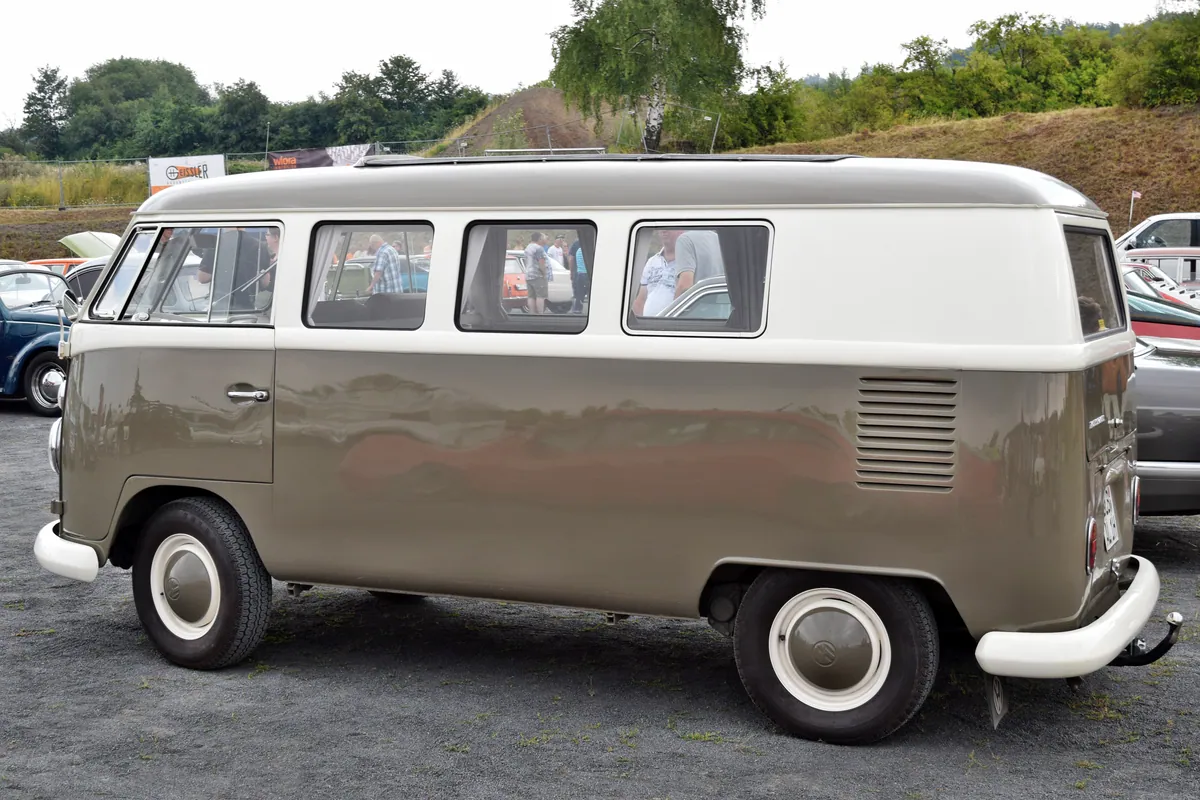
After 56 years of production in Brazil, the van left the assembly line in 2013 when new rules required ABS brakes and airbags.
The Volkswagen Kombi began with a sketch by Dutch importer Ben Pon. In 1947, at Volkswagen’s German factory, he saw an improvised cargo platform built on a Beetle chassis and drew a proposal for a van with a unitary body and rear-mounted engine. German production began in 1950. Its simple mechanics and capacity to carry up to 750 kilograms helped make the design an immediate success.
Assembly in Brazil began with imported components in São Paulo’s Ipiranga district in 1953. On September 2, 1957, the Anchieta plant in São Bernardo do Campo began local production, making the Kombi the first Volkswagen model manufactured outside Germany. It remained part of Brazilian daily life for more than half a century.
The name is a shortening of the German Kombinationsfahrzeug, a vehicle combining passenger and cargo transport. The van acquired different nicknames around the world. In Brazil, late production versions were called “Velha Senhora”. in Portugal, “Pão de Forma”. in the United States, the model became known as the “Hippie Van” or “Vee Dub” through its association with 1960s counterculture.
Production ended in December 2013 after Brazil set new safety requirements for vehicles manufactured from 2014: ABS brakes and dual airbags. The Kombi’s front-cab structure could not accommodate airbags without major redesign. The final farewell was the Kombi Last Edition, limited to 1,200 numbered vehicles with two-tone paint and retro details.
With the end of production, demand for well-preserved examples grew. Early vans from the 1950s to 1970s, especially the split-windshield “Corujinha” version, began fetching higher prices at overseas auctions. A utility that had served commerce and family travel for 56 years became a fixture of collections and automotive museums.