
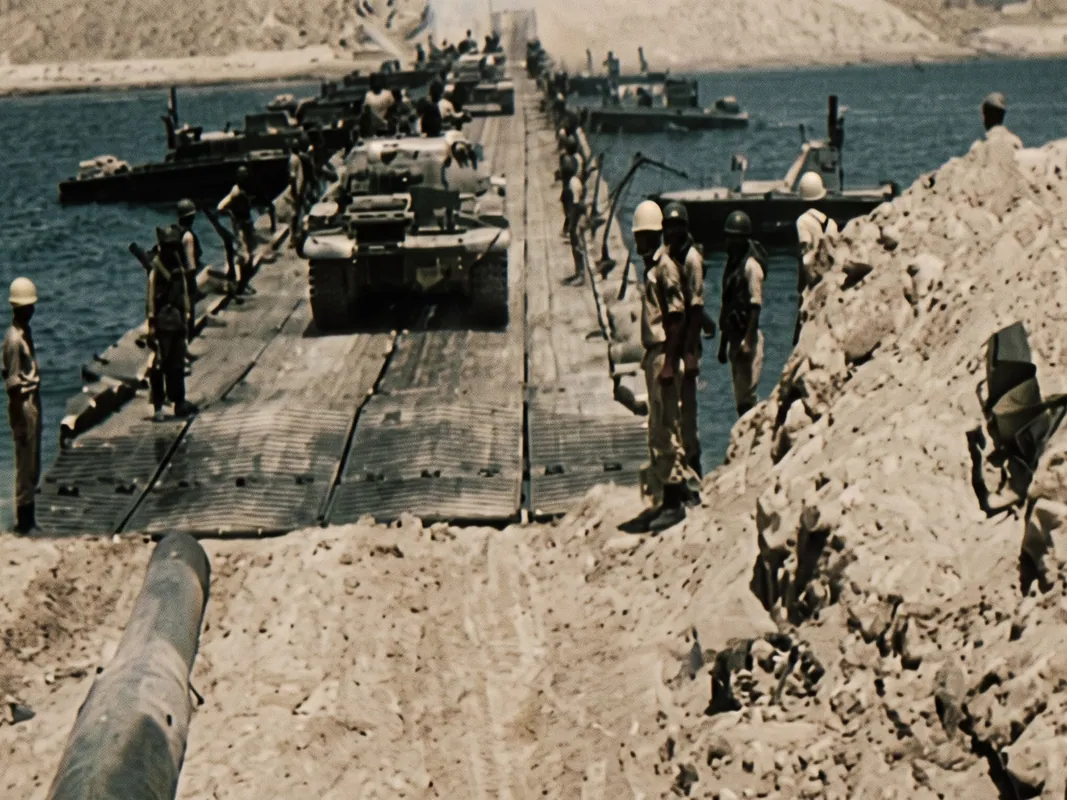
Egyptian troops used water pumps to cut passages through the sand embankment, but, as an Al Jazeera film recounts, the opening hours tested Israel’s entire defensive system.
In the opening hours of the October 6, 1973 war, Egyptian engineers began cutting gaps in the Bar-Lev Line’s sand embankment with water pumps. An Al Jazeera documentary presents the episode not as the sole explanation for the breakthrough, but as one part of an operation against a wider defensive system.
After the 1967 war, Israel built fortified positions, tank emplacements, command posts and roads on the eastern bank of the Suez Canal to move reserves quickly. The line was not one continuous wall: it was designed to be supported by mobile armoured forces in the depth of Sinai.
The concept of fixed fortifications was to slow an attack and buy time for reinforcements and a counterattack. It depended, however, on tanks reaching the front quickly and on roads, communications and supply lines remaining open. A study by George Gawrych of the U.S. Army’s Combat Studies Institute says the line remained a serious obstacle despite the reduction of troops stationed there before the war.
The Egyptian operation combined artillery preparation, infantry crossings by boat, engineering work and the consolidation of bridgeheads. The infantry was expected not simply to wait for bridges, but to approach the strongpoints, occupy tank positions and resist armoured counterattacks. Water pumps helped open the embankment so bridges, ferries and vehicles could cross the canal.
Egyptian forces on the eastern bank carried anti-tank weapons, making a rapid Israeli armoured counterattack more dangerous. In the film’s account, the fortifications were vulnerable not only to fire: their purpose depended on secure roads, timely reserves and reliable communications with the rear.
The documentary combines archival footage of the crossing, prisoners of war and military operations with computer-generated reconstructions of the defences. Al Jazeera says its AI-generated visualisations are clearly marked. Egypt’s Al-Ahram newspaper has also described the use of water pumps as an engineering method for rapidly cutting passages through the embankment.