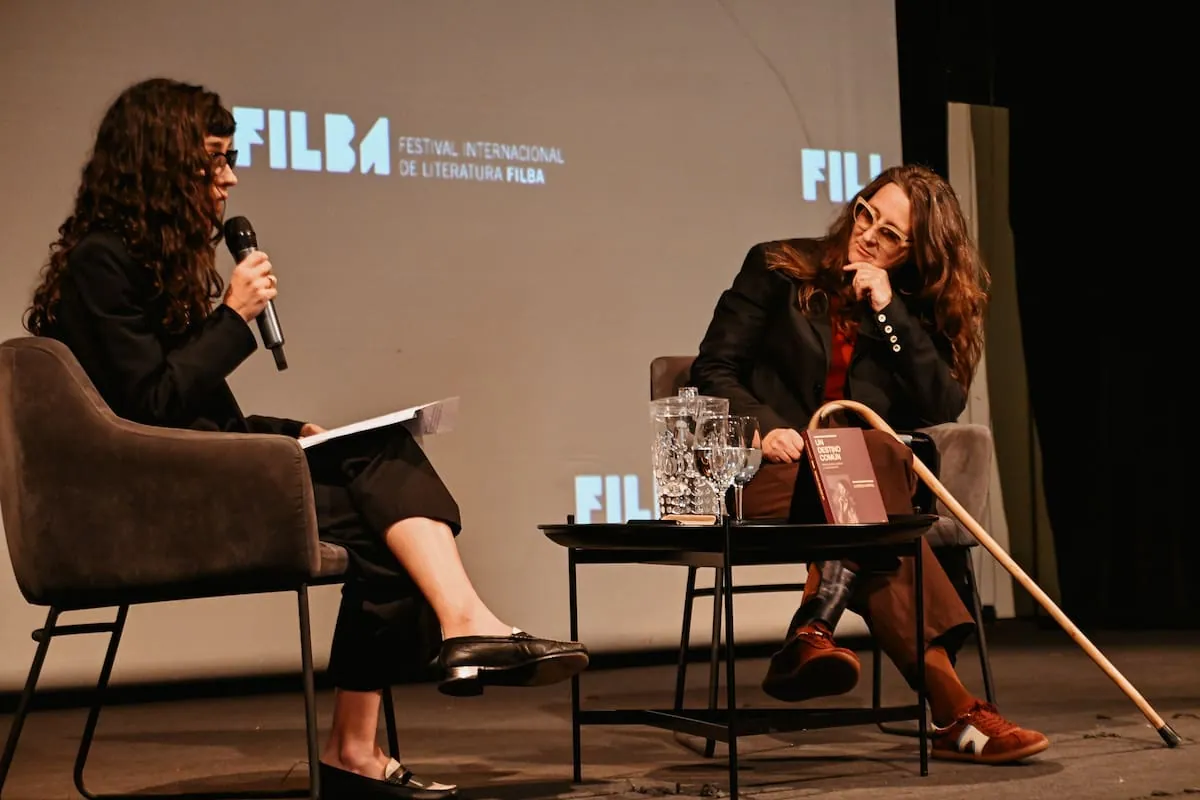
At the close of Buenos Aires’ Filba literary festival, the Argentine filmmaker reflected on her 14-year documentary about land and violence, bureaucracy as a measure of inequality, and cinema’s role in public conversation.
Argentine filmmaker Lucrecia Martel closed the Filba literary festival with a conversation about cinema, inequality and shared spaces. The event filled the auditorium at the Museum of Latin American Art of Buenos Aires (Malba). Filba drew about 13,000 in-person visitors over five days, with more than 20,000 additional connections to its livestreams, La Nación reported.
A central subject was Martel’s documentary Nuestra Tierra, which premiered at the 2025 Venice Film Festival. The film explores Indigenous communities, particularly Chuschagasta in Tucumán province, and the 2009 killing of community leader Javier Chocobar. Martel said she worked on the film from 2011 to 2025, examining violence, land and power. Its editing required selecting material from roughly 400 hours of footage and more than 5,000 photographs. She said she hoped the finished work would help generate conversation.
Martel described bureaucracy as a way to measure inequality: a person’s social position can determine how many offices they must visit and how long they wait for a decision. Chuschagasta’s claim to land rights passed through four offices over 19 years. The community had repeatedly asked the Tucumán government to consider expropriation of land whose ownership was contested in claims dating back to the 17th century.
She said Argentina’s national origin story leaves Indigenous people, Black and mixed-race communities, and women outside its frame. Martel contrasted people who live with the risk of being forced from their homes with those less exposed to day-to-day insecurity. She also connected Nuestra Tierra to themes in her earlier films, including La Ciénaga, The Holy Girl, The Headless Woman and Zama, which explore family, adolescence, religion, silence and colonial power.
Martel said she was less interested in the prestige of festivals than in screening the film for communities and talking with audiences. She described cinema as a way to alter perception and imagine alternatives in the face of violence. At the end of the conversation, she encouraged the audience to state their wishes and imagine how change might begin.