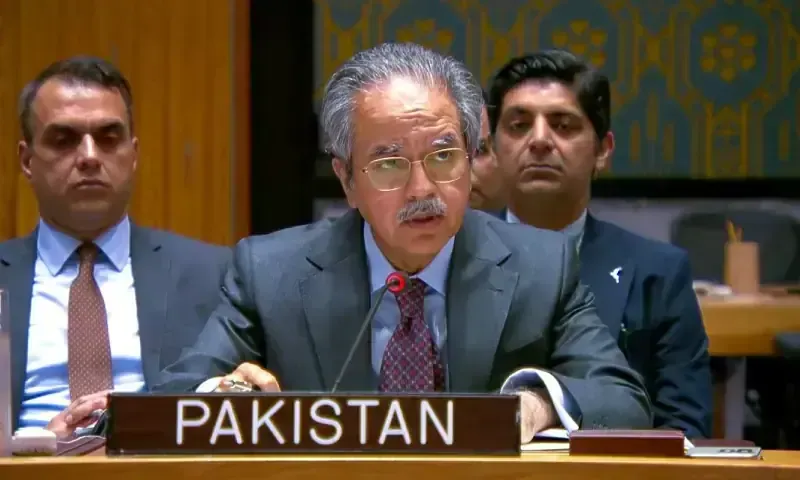
Islamabad wants to expand the number of elected Council members rather than add permanent members. Pakistan’s UN envoy Asim Iftikhar Ahmad argues that expanding the privileged category would not make the body more representative.
Pakistan opposes adding new permanent members to the UN Security Council and instead supports increasing the number of elected members of the 15-seat body, Ambassador Asim Iftikhar Ahmad told Dawn while reviewing Pakistan’s 2025–26 term. Ahmad is due to return to Islamabad to take up the foreign secretary’s post.
Ahmad said criticism of the permanent members has reinforced calls for a more democratic and accountable Council. Islamabad supports additional elected seats, including medium-term positions allocated through periodic elections and rotation. The position aligns with the Uniting for Consensus group, which opposes creating new individual permanent seats.
Pakistan’s 2025–26 service was its eighth term on the Security Council. For Ahmad, it was his third consecutive Council assignment, following earlier postings in 2003–04 and 2012–13. He listed conflict prevention, peaceful dispute settlement, peacekeeping, counterterrorism and cooperation with regional organisations among Pakistan’s priorities.
Ahmad cited Security Council Resolution 2788, adopted unanimously in July 2025 on Pakistan’s initiative, as a major achievement. The resolution renewed attention to the UN Charter’s mechanisms for peaceful settlement of international disputes. He said Pakistan had built consensus around it despite divisions within the Council.
The term unfolded amid sharp geopolitical tensions, including a four-day military confrontation between India and Pakistan in May 2025. Ahmad said the crisis underscored the importance of diplomacy in preventing escalation. He also described Pakistan as playing a mediating role in US-Iran contacts, including an April ceasefire, talks in Islamabad and a memorandum of understanding signed in June. These assessments were presented as the diplomat’s account.
Ahmad said Pakistan supported the Gaza plan and Resolution 2803, which he linked to a ceasefire, humanitarian access and a political path toward Palestinian statehood. Islamabad also raised the Jammu and Kashmir dispute at the Council and called for a peaceful settlement in line with UN resolutions.