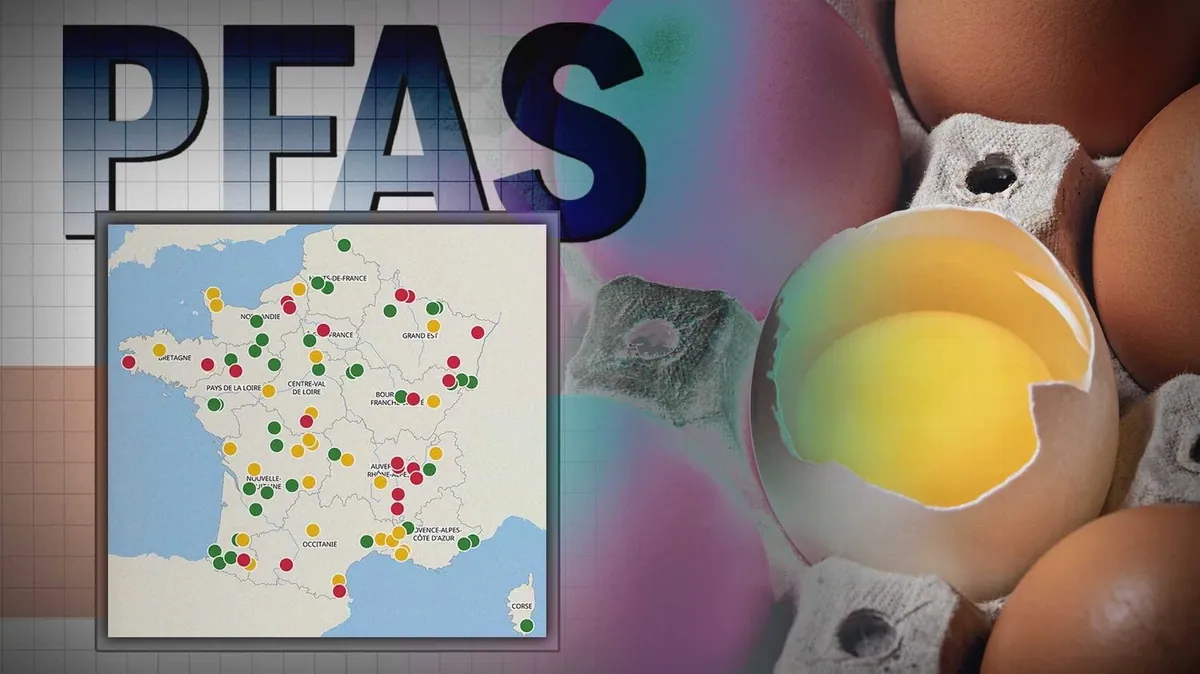
An ICI and Radio France investigation detected the chemicals in 52 of 91 samples. Twenty-three exceeded quality limits.
The ICI regional network and Radio France’s investigative unit tested 91 eggs from free-range hens collected across France. PFAS were found in 52 samples, and 23 exceeded the quality limits used in the investigation. Four of the exceedances involved eggs bought from producers. The reporters noted that the samples do not amount to a nationwide survey of all eggs.
The highest level was measured at the farm of Anne and Sébastien Abraham in the Ardennes, where concentrations were nearly 40 times the limit. The family had already found PFAS in the soil and well at its farm in Haraucourt. The investigation linked the contamination to wastewater sludge from a paper mill in Stenay that a previous landowner had spread on the property. The couple had invested more than 500,000 euros in a vegetable-growing project, which is now suspended.
In Pierre-Bénite, near an Arkema plant that produces PFAS, a private household’s eggs measured ten times the limit. A sample in Communay was twice the limit. Other exceedances were reported in several communities, including Chartres-de-Bretagne, where investigators said no obvious industrial source had been identified.
The laboratory tested four compounds: PFOS, PFOA, PFNA and PFHxS. Exceeding a quality limit does not mean consumers will automatically become ill, but it indicates exposure to persistent pollutants. Citing an EFSA assessment, the report gave a benchmark of no more than one egg a week for a 20-kilogram child and four for a 70-kilogram adult if eggs contain PFAS at the limit. That calculation does not include other foods. Toxicologist Xavier Coumoul urged particular caution for children and pregnant women.
For commercial producers, an exceedance can lead to a sales ban. The investigation also highlighted sewage sludge used on farmland as a possible route for pollutants to reach soil and water. Experts are assessing the cases, and French authorities are discussing whether to reactivate a compensation fund. Investigations are continuing.