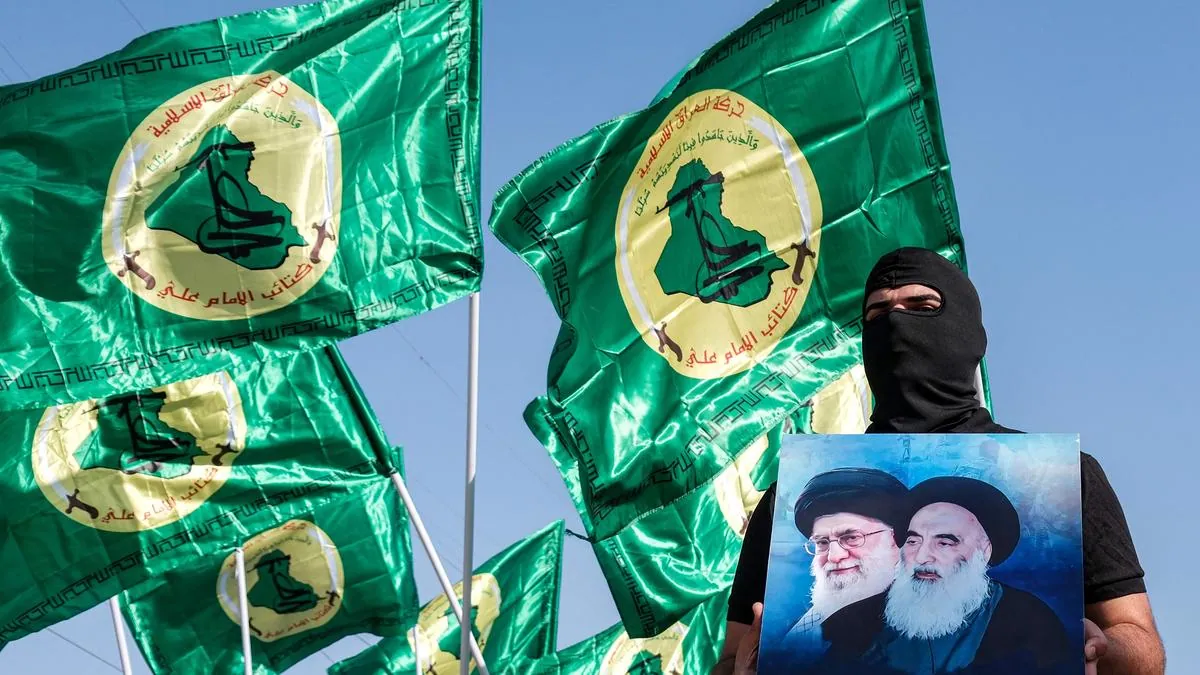
After the United States completed its military withdrawal from Iraq, the Shia Popular Mobilisation Forces called it a victory. But their own disarmament remains unresolved, with powerful Iran-aligned factions resisting the government’s plans.
The Popular Mobilisation Forces (PMF), or Hashd al-Shaabi, trace their origins to an emergency call by Iraq’s leading Shia cleric, Grand Ayatollah Ali al-Sistani, in June 2014. After Islamic State fighters captured Mosul, he urged citizens able to bear arms to join the army and security forces to defend the country and its shrines.
Hundreds of thousands of young Iraqis responded. The mobilisation quickly expanded beyond the army and police as existing Shia militias and new armed groups gathered under the PMF umbrella. Baghdad encouraged their expansion, while Iran provided some factions with funding, weapons and training. PMF groups fought alongside Iraqi forces against Islamic State, with U.S. air support.
The defeat of the group did not dissolve the PMF. A 2016 parliamentary law institutionalised it as a separate organisation within Iraq’s armed forces, while factions retained their own command structures. Some formed political blocs. The Hindu reports that the PMF now comprises more than three dozen militias, an estimated 240,000 fighters and an annual budget of about $3.4 billion.
The PMF has included Iran-aligned factions, shrine units associated with al-Sistani and the Sadrist movement. Shrine units left the structure in 2020 and came under the direct authority of the commander-in-chief. Powerful Iran-backed groups, including Kataib Hezbollah and Harakat Hezbollah al-Nujaba, have resisted calls to disarm.
After U.S. troops completed their withdrawal on Sept. 30, Prime Minister Ali al-Zaidi said the demobilisation process had begun, but moved the deadline to June 2027. Some groups, including Kataib Imam Ali and Saraya al-Salam, have reached agreements with the government to hand over weapons and regularise their status. More powerful factions say armed resistance will continue while U.S. forces remain in the region.
The standoff is especially sensitive amid tensions between Washington and Tehran. Iraqi officials, according to the source, say the United States and the militias agreed to refrain from attacks for 90 days after the withdrawal. But any escalation around the unresolved war with Iran could again turn Iraq into a battleground. Security officials also fear that reduced U.S. intelligence and logistical support could give Islamic State sleeper cells room to regroup.