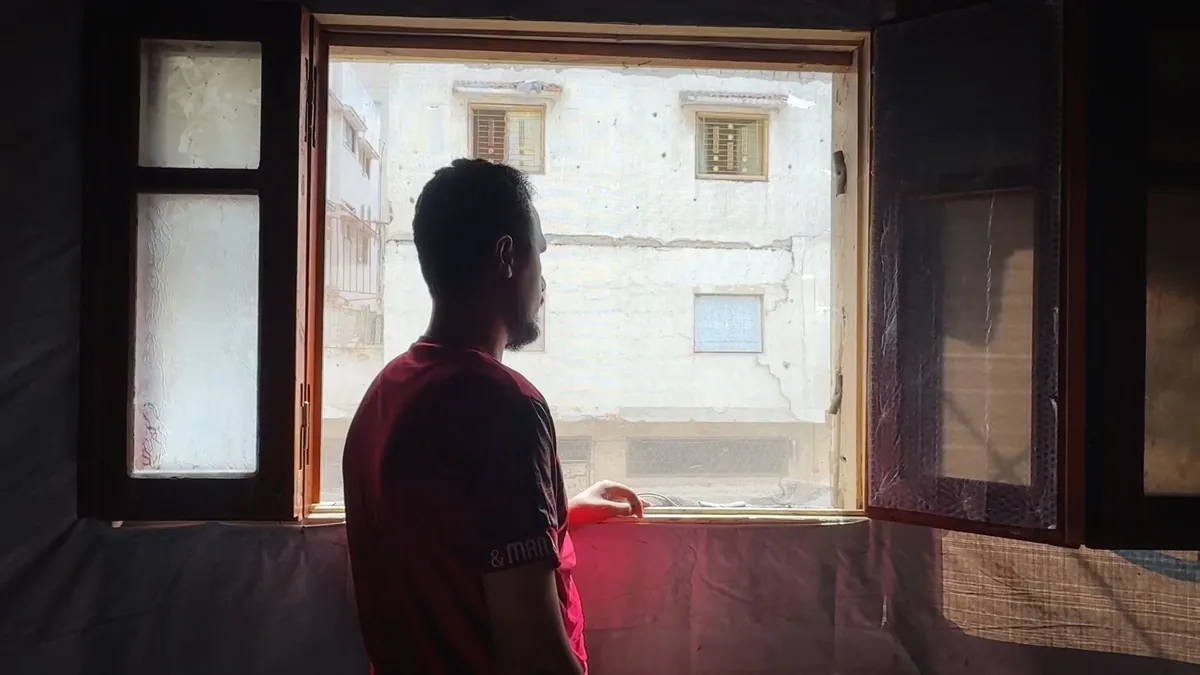
In a report for Al Jazeera Net, residents of Gaza recount life after severe injuries and the deaths of loved ones. Their accounts include a father who lost his sight, a child who lost an arm, a woman with lasting memory problems and a student continuing her studies after losing her hearing.
For the third anniversary of October 7, Al Jazeera Net published a report on Gaza residents whose losses are not always visible. The accounts of four people show how injuries and the deaths of relatives reshaped survivors’ everyday lives. Details of the incidents are attributed to the people and family members interviewed.
Ramadan al-Ashram, 28, lost his sight after a head injury. He told the outlet that a bullet fired by an Israeli sniper passed through his head and exited through his right eye. Doctors removed the damaged eye; he was later told that treatment outside Gaza might offer a chance to save the sight in his left eye. Despite receiving a medical referral, he was still waiting for a chance to leave for treatment, the report said. During displacement, he had to rely on someone to guide him because he feared falling.
Another person featured is nine-year-old Kinan Abu Jibba, who lost his right arm and his family when their home in Gaza City’s Shujaiya neighborhood was struck when he was six. He spent hours trapped under the rubble before rescuers pulled him out. A year ago, he returned from treatment in the United Arab Emirates with a prosthesis, but he has since outgrown it. The report says he hopes to clap with both hands, hold a ball and dress and eat independently.
Kawthar Nasr survived the destruction of her home but, according to doctors cited in the report, suffered damage to her olfactory nerve and lost her sense of smell and taste. In the first week of the war, she lost her husband, two sons and grandchildren; she now cares for two surviving granddaughters. She said she eats to stay alive rather than for enjoyment, and that losing her sense of smell affects even her time near the kitchen.
Aida, 55, lost two sons and their families in a strike in Khan Younis on January 11, 2024. Her daughter Siham told the outlet that relatives initially concealed the deaths to spare her further distress. After she was told what had happened, Aida stopped eating and swallowing and later fell into a coma for about a year. After waking, she needed help with daily activities and had lost her ability to speak. Her daughter also described changes in Aida’s sense of fullness and memory.
Student Azza al-Amour was trying to connect to the internet on the roof of her home in Khan Younis to take a university exam when a falling missile injured her head. The report says the injury left her deaf and unable to move the left side of her body. After rehabilitation she began walking again, but her hearing did not return. Her mother communicates by moving her lips slowly or writing; Azza carries a small notebook and is continuing her final year in psychological counseling.
Together, the accounts describe losses that extend beyond visible wounds: people adapting to the loss of sight, hearing, smell, taste, memory and independence. The report conveys the experiences of specific families and does not present them as a statistical picture of all those affected.