
Research links social touch with attention, closeness and a sense of safety, but does not assign one definite meaning to this particular gesture.
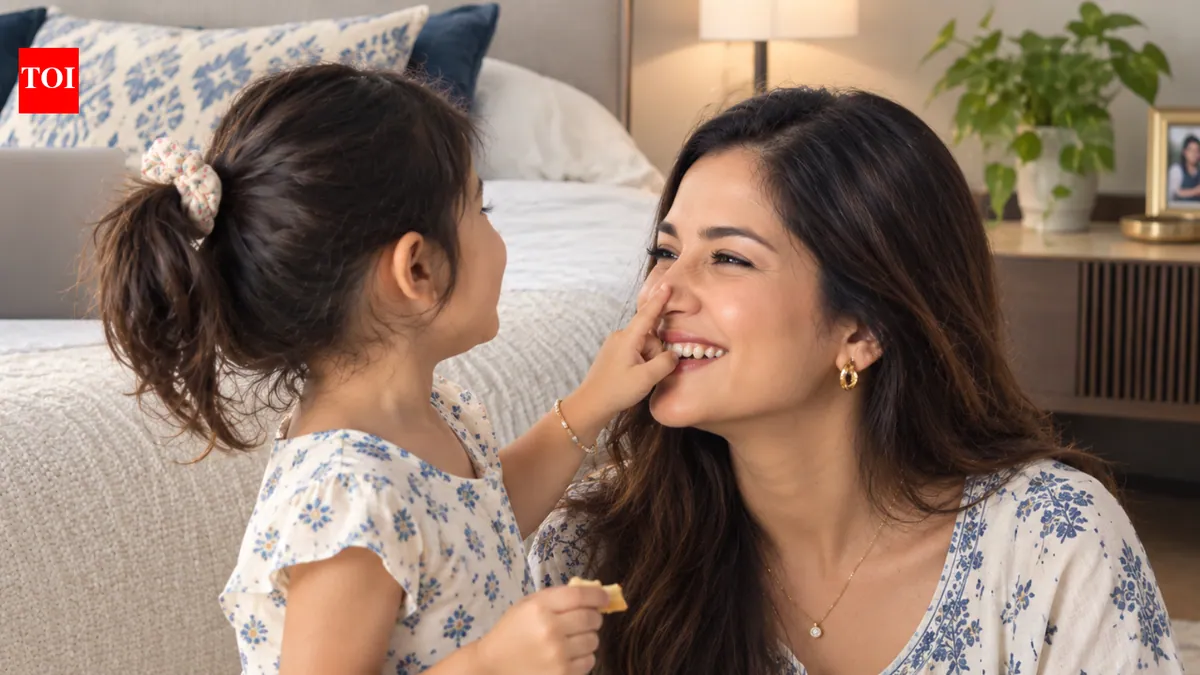
When a child tells a parent about something that happened at school, they may move quickly from one detail to another while reaching for the adult’s face: touching a cheek, tracing an eyebrow, holding the chin or tapping the nose. The parent moves the hand away, but a few seconds later it returns. It can be easy to dismiss this as fidgeting or mischief. Yet touch often accompanies children’s communication, and it does not have one fixed psychological meaning.
There is no scientific basis for saying that touching a parent’s face always means the same thing. Research on social touch offers possible reasons some children bring physical contact into a conversation: it may help them stay close, regain attention, settle themselves or express affection. But the studies discussed here did not examine what a child’s face-touching gesture means specifically.
For a young child, communication is rarely limited to words. A child may lean against a parent, hold a hand, sit close or play with the parent’s hair. A review of research links social touch with attachment, communication, social learning and emotional regulation, processes that are especially important in early childhood as the brain and social relationships develop. Touch can therefore be one way a child stays engaged in an interaction.
A parent’s face is an important source of social cues. Children watch facial expressions to see whether an adult is smiling, annoyed, listening or reacting to a story. In a study of 39 mothers and children aged four to six, researchers observed a 10-minute play session and then measured how strongly the children oriented toward social information, including faces. More frequent maternal touch was associated with stronger social orienting. The researchers did not study children touching their parents’ faces, so the finding does not directly explain that gesture or establish cause and effect.
If a parent is cooking, looking at a phone or working at a laptop, a child may keep talking, repeat a point, move closer or touch the parent’s face. Automatically labelling that behaviour as “attention-seeking” would be an oversimplification, although touch can be one way of bringing an adult back into a conversation. What matters is not only the hand on the cheek but how parent and child respond to each other.
Physical contact may also support a sense of safety. In an experiment involving 138 parent-child pairs aged 8–10 and 11–14, one group of parents was asked to briefly and gently touch the child’s shoulder, while a comparison group did not. Children in the touch group showed less implicit attention to social threat. Among children with higher social anxiety, touch was also associated with greater trust. The effect appeared among the younger participants, not adolescents. The study examined a parent touching a child’s shoulder, not a child touching an adult’s face, so it cannot establish a specific motive for the gesture.
Sometimes the explanation is simpler: the child enjoys being close. One child may show affection with hugs, another may climb into a parent’s lap, hold a hand or rest their head on a shoulder. For some children, touching a cheek or playing with hair becomes a small ritual of closeness. Research reviews associate warm, responsive touch with parent-child bonding and interactional synchrony. That does not mean every gesture should be assigned a particular hormonal or brain response.
Parents can also over-psychologize ordinary childhood habits. A child might touch a nose because it is funny, like the softness of a cheek or have noticed that the adult laughs. Children explore people and their surroundings through their senses, and touch is one of the earliest ways they do so. A repeated gesture does not necessarily signal an unmet emotional need.
Context helps clarify what may be happening. If the child touches a face during an affectionate conversation, it may be part of connecting; if the parent is distracted, it may be an attempt to regain engagement; if the child is tired or upset, contact may be comforting. If the child does it with everyone in many situations, sensory curiosity or habit may be a better explanation. None of these interpretations applies universally.
Rather than asking, “What does touching my face mean?”, it may be more useful to ask, “What is happening between us right now?” The child may be keeping the conversation close, checking whether the adult is listening, expressing affection or calming themselves through familiar contact. Or they may simply find Mum’s nose very funny. There is no single psychological answer; the gesture’s meaning depends on the relationship and context.