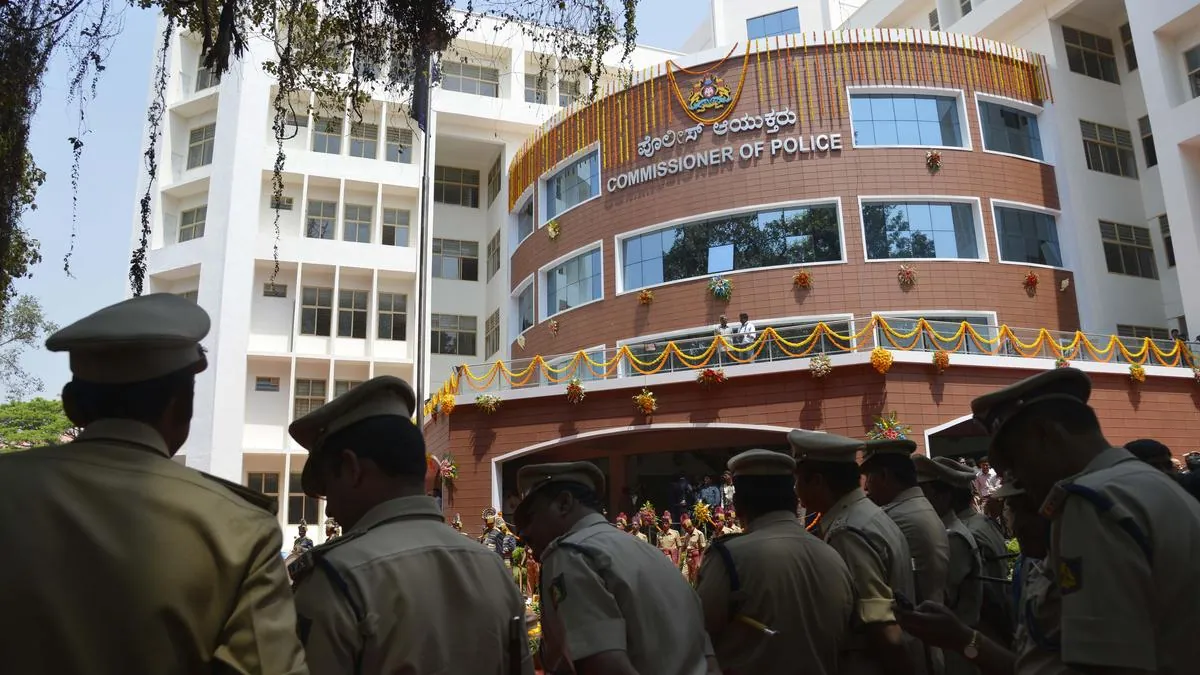
Karnataka’s Cabinet has approved a plan to divide Bengaluru’s police into five commissionerates under a Chief Police Commissioner. Some former officers expect closer local policing, while others warn of command, coordination and cost risks.
Karnataka’s Cabinet has approved a reorganisation of Bengaluru police into five commissionerates under a Chief Police Commissioner. The plan comes as the city expands and the Greater Bengaluru Authority (GBA) divides civic administration into five corporations. Supporters expect closer coordination between police and civic bodies. But former senior officers disagree over whether municipal boundaries should be mirrored in a police system where crime, traffic and emergency response often cross them.
A former Director General of Police who served in Bengaluru warned that several command centres could weaken the existing chain from the city police commissioner through deputy commissioners, inspectors and constables, while creating overlapping responsibilities. At present, the city commissioner can deploy personnel across Bengaluru. Under the new model, the former officer said, a major emergency would require coordination among multiple commissionerates. VIP movements could pose similar problems: if a Prime Minister or President’s convoy crosses several jurisdictions, units might duplicate security and specialist deployments, including those of the City Armed Reserve.
The former DGP also questioned the cost. In addition to about 6,000 proposed posts, five separate establishments would need offices, vehicles, communications systems, accommodation and administrative staff. He argued that the money would be better spent on police stations, investigations, beat policing and staffing. He also warned that residents could be unsure which commissionerate handles an area or an incident spanning several jurisdictions, given the proposed five commissioners and a Chief Police Commissioner.
Another former city commissioner agreed that Bengaluru needs decentralised policing but proposed a leaner two-commissionerate structure: one for the urban core and another for rapidly growing peripheral and rural areas beyond the Outer Ring Road. Additional Superintendents of Police could be redesignated as Deputy Commissioners of Police (DCPs) and given wider territorial responsibility. He pointed to the 2016 reorganisation, which created Whitefield and Electronic City divisions, opened police stations and gave the Central Crime Branch police-station powers. In his view, those changes improved local supervision and eased pressure on the central establishment at comparatively lower cost.
The proposal also has supporters among former police officials. They say five smaller jurisdictions could help address local law-and-order, traffic and policing demands and allow senior officers to work more closely with the relevant civic corporations. They stress, however, that the system’s success would depend on clearly defined boundaries, powers and responsibilities, as well as reliable coordination among the commissionerates.
Critics note that organised, cyber and financial crime, drug networks, major incidents, traffic corridors and public events do not stop at municipal borders. Police jurisdictions, they argue, should be designed around population, crime patterns, geography, traffic flows, police-station workload and emergency-response needs, rather than automatically matching the GBA’s five corporations. Officers on both sides agree that Bengaluru needs more personnel and stronger field-level policing.
The central question is whether the approved structure will deliver faster response, effective mobilisation, stronger investigations, better traffic management and clear accountability. Former officers opposing five separate establishments have urged the government to assess operational and financial consequences before implementation, warning that a large restructuring could be expensive and difficult to reverse. Supporters say smaller commissionerates can meet the city’s needs if their jurisdictions are clearly set and coordination works.