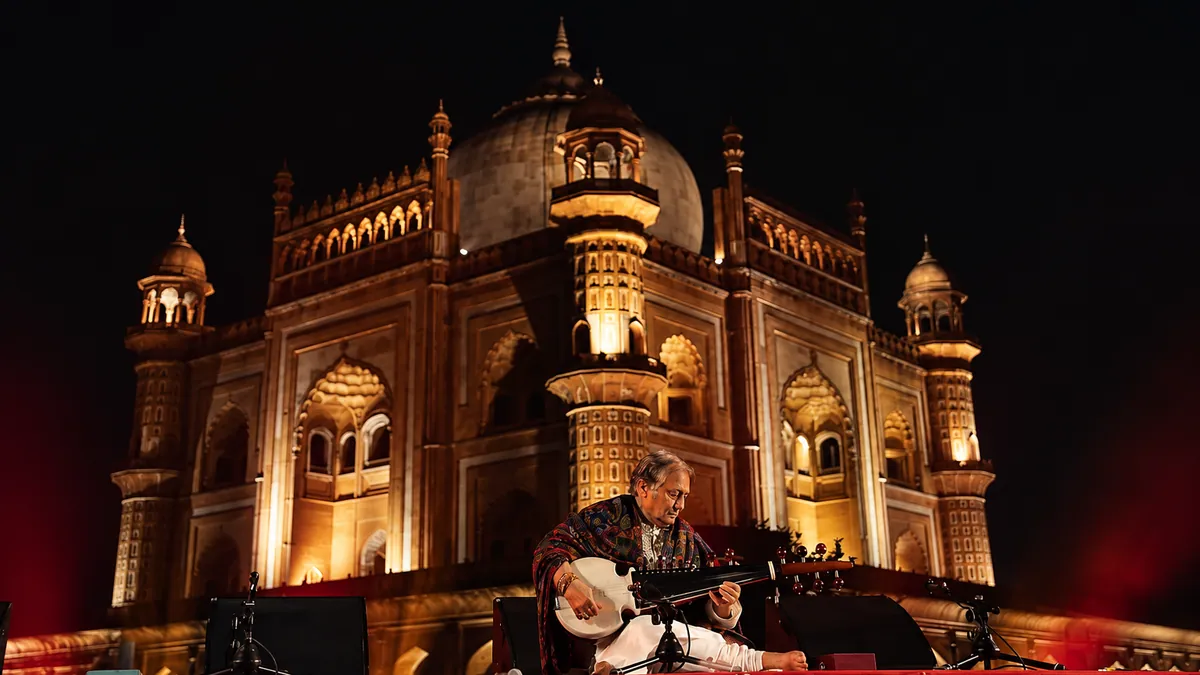
Music programmes featuring Amrita Kaur and Vishal Bhardwaj are scheduled this weekend at Purana Qila and Safdarjung Tomb. Organisers are increasingly treating heritage sites as part of the performance rather than just its backdrop.
Inkpot India’s programme at Purana Qila lists two Amrita Kaur concerts at dusk and dawn on October 10 and 11. The Songs of the Stone series combines music with storytelling, craft activities and a chance to experience the fort. The following day, around 500 listeners are expected at Safdarjung Tomb for Ghazal Aur Baatein, an evening when Vishal Bhardwaj will sing ghazals and share the stories behind them.
The format operates under monument-conservation rules. Archaeological Survey of India (ASI) guidelines adopted in 2005 allow cultural programmes at selected sites, while restricting lighting, sound, crowds, parking and temporary structures. Events generally have to end by 10 p.m., and the framework bars ticketed or paid admission. Purana Qila and the open area around Qutub Minar were among the sites considered for such programmes.
The 2023 Adopt a Heritage 2.0 programme broadened the role of outside partners in improving amenities and visitor experiences. The following year, Sabhyata Foundation was named Smarak Sarthi for Purana Qila, Safdarjung Tomb, Humayun’s Tomb and Mehrauli Archaeological Park. Alongside cultural events, paid curated experiences and event spaces are appearing at heritage sites.
Preservation remains the central condition. Malini Thadani of the World Monuments Fund India Association says an event’s scale should match a site’s condition and capacity. Some monuments may only suit small concerts, or no events at all. Simar Malhotra, organiser of Songs of the Stone, said her programmes follow ASI limits on sound and capacity. Noise must stay within 10 dB(A) above the local ambient standard or 75 dB(A), whichever is lower.
Recent disputes show why the commercial model can be contentious. Tickets for the Jahan-e-Khusrau festival at Purana Qila in March reportedly cost between 2,500 and 10,000 rupees. ASI complained to police about stalls and kiosks it said were unauthorised. At Sunder Nursery, by contrast, renting historic grounds is part of the operating model: its amphitheatre is listed from 65,000 rupees a day, with larger venues costing more.
Another approach is visible at Kathika Cultural Centre and Museum in Old Delhi. It is not an ASI site, but two privately restored 19th-century havelis. Its daily programme includes music, Kathak, storytelling and local food. Founder Atul Khanna said cultural programming gives restored buildings a contemporary use and a source of maintenance income. Organisers and conservationists face the same question: how to bring new audiences to monuments without turning them into ordinary commercial venues.