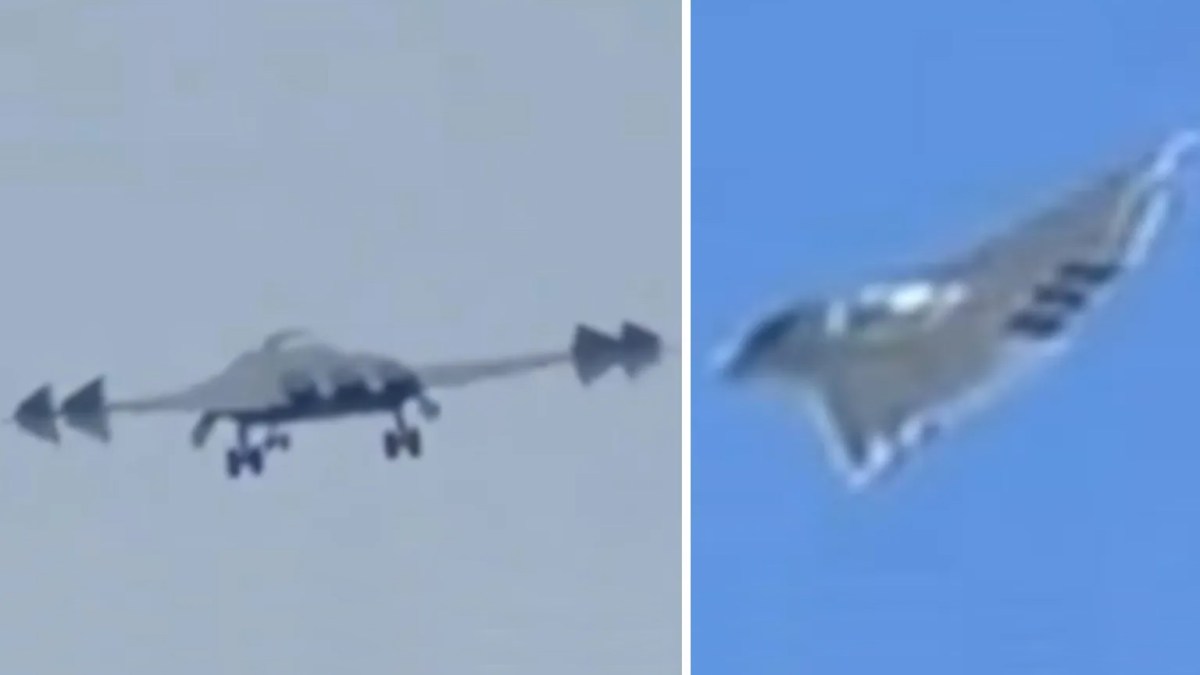
The footage, posted on social media, captures the J-36 rolling in for a landing and reveals a distinctive two‑dimensional thrust‑vectoring exhaust that replaces the earlier trough‑style nozzle, a configuration reminiscent of the U.S. F‑22 Raptor.
In addition to the new exhaust, the aircraft now features divertless supersonic intakes (DSIs) not only on the top of the fuselage but encircling the airframe, a change first observed in 2023 and now confirmed on the latest prototype.
Observers noted a lighter‑colored radome and a similarly hued section atop the dorsal intake, markings that first appeared on a fourth prototype in July and may indicate the installation of an operational radar array in the nose.
A second video released earlier this week shows the jet’s upper surface dotted with multiple lighter‑colored panels that appear to be conformal antenna apertures; the aircraft’s leading and trailing edges are also painted in a two‑tone scheme that mirrors the low‑observable finish of operational J‑20 fighters.
Analysts estimate that at least four, and possibly five, J‑36 prototypes are now flying, with some evidence suggesting the serial number 36011 may be applied to several airframes as a counter‑intelligence measure.
The J‑36 was first unveiled alongside the J‑XDS in December 2024; since then, Chengdu has iteratively refined the design, shifting emphasis toward straight‑line speed, payload capacity and long‑range communications rather than extreme maneuverability.
Separate speculation about a laser directed‑energy weapon stems from an AVIC exhibition placard describing a “laser weapon tracking system” rated in the hundreds of kilowatts, but no official confirmation exists that the J‑36 will be equipped with such a system.
Aviation analysts, including TWZ contributor Andreas Rupprecht, argue the jet could serve as a “theater‑level deep‑penetration command combat aircraft,” acting as a node for unmanned systems and long‑range strike missions, though these roles remain unverified.
The continued rollout of the J‑36 underscores China’s push to field a heavy, stealthy tactical platform that blends fighter‑like speed with bomber‑style payload, a development that U.S. officials note as a gap compared with America’s own sixth‑generation fighter programs slated for the late 2020s.