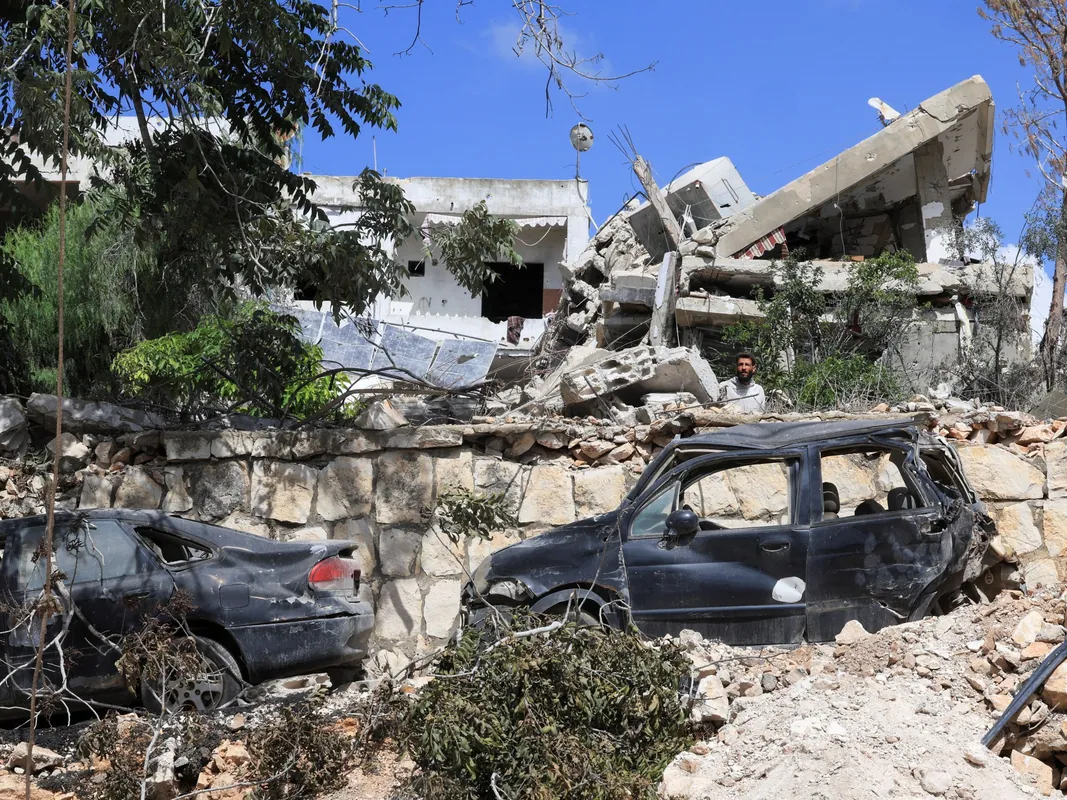
Although Israeli forces withdrew from Zawtar al-Gharbiyeh under a June framework, troops remain in nearby villages. Residents report drone surveillance, explosions and restrictions, while many returnees still lack basic utilities.
Mariam al-Yaghi sees military vehicles only a few hundred metres from her home in southern Lebanon’s Zawtar al-Gharbiyeh. At night, Israeli patrols pass so close that she can hear soldiers. During the day, a small Israeli drone often follows her as she works in her garden. Explosions echo through the morning as Israeli forces demolish homes in occupied neighbouring villages with controlled blasts and bulldozers.
Israeli forces withdrew from Zawtar al-Gharbiyeh in July under a U.S.-backed plan for “pilot zones.” It envisages a gradual Israeli withdrawal from southern Lebanon in exchange for Hezbollah’s disarmament and the Lebanese army’s deployment. Two months later, no additional zones had been agreed. Residents say their town has not become a model for safe return. The Israeli military told Reuters that work to remove the threat from Hezbollah’s weapons was not complete. It said drones were being used to monitor threats and movement restrictions were intended to protect its forces. The area would expand after the Lebanese army completed a sweep of the first zone.
More than a million Lebanese fled their homes about seven months ago, when Israel launched airstrikes and a ground invasion alongside the war with Iran. After a June ceasefire, Israeli forces continued strikes that killed and wounded dozens. Israel still occupies parts of Lebanese territory that it unilaterally declared a security zone. The area includes dozens of villages, many of them heavily damaged.
About 70 families have returned to Zawtar al-Gharbiyeh. Most live in undamaged parts of their homes, which they consider preferable to paying rent elsewhere or staying in displacement shelters. Lebanon’s Council of the South provided 16 prefabricated homes for families whose houses were uninhabitable, but most remain empty because there is no electricity or running water. Few of Mariam’s neighbours have returned. Tank tracks cut through her garden, where olive trees she tended for decades lie uprooted. The start of the harvest brought hope, but the damaged trees and restrictions have made work difficult. Some residents mock the idea of needing Washington’s permission to pick olives. Others fear approval may arrive after the season ends.
In neighbouring Zawtar al-Sharqiya, Israeli forces remain and continue demolitions. Abed Ezzeddine, mayor of Zawtar al-Gharbiyeh, told Reuters the pilot-zone programme had failed, mainly because public services, including electricity and water, were still largely unavailable. Lebanese President Joseph Aoun said on October 8 that Israel was violating the U.S.-brokered framework agreement. He called for an end to the destruction of homes and the return of detainees. Lebanon also needs equipment and vehicles so its army can carry out its duties in the south and deploy to the internationally recognised border, he said.
Lebanon’s state-run National News Agency reported Israeli artillery fire in Wadi Zibqin on Thursday. Reports also described strikes in Wadi al-Hujayr, Wadi al-Saluqi and the Khiam plain, as well as in Haddatha, Haris, eastern Zawtar, Kfar Tebnit, Baraachit and Nabatiyeh al-Fawqa. Israeli forces also carried out demolitions in Beit Yahoun, Houla, Tallousa, Mansouri and Aitaroun. The attacks continued despite the framework agreement signed on June 26, which provides for a gradual Israeli withdrawal and the deployment of the Lebanese army in areas vacated by Israeli troops.
Hezbollah leader Naim Qassem said the group would continue resisting as long as Israeli attacks continued and rejected calls for concessions before a withdrawal. Those remarks reflect the group’s position and are not an agreed part of the framework.
Lebanese authorities say Israeli attacks since March 2 have killed at least 4,386 people, wounded 12,413 and displaced more than a million. The damage is greater when counted from October 8, 2023, when Hezbollah-Israel clashes began amid the Gaza war. Israel has completely destroyed tens of thousands of homes, partially damaged about 65,000 and caused minor damage to roughly 320,000 more. A joint assessment by Lebanon’s Agriculture Ministry, National Council for Scientific Research and the U.N. Food and Agriculture Organization put agricultural losses at $530.5 million. About 22.5% of farmland has been affected, according to Lebanon’s agriculture ministry. Prime Minister Nawaf Salam said in September that the wars in 2023 and 2026 had cost Lebanon more than $20 billion, with the total potentially exceeding $27 billion.