
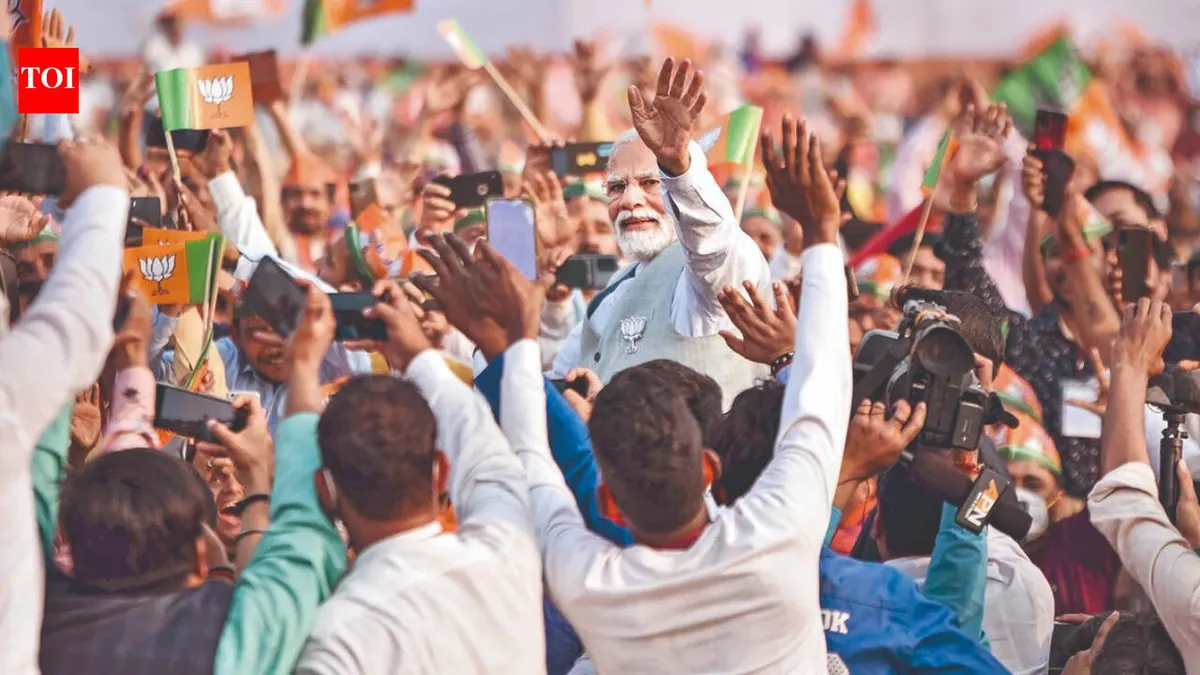
October 7 marks 25 years since Narendra Modi first took charge of a government, beginning as Gujarat’s chief minister. The Times of India traces his path to a third term as India’s prime minister.
Narendra Modi became Gujarat’s chief minister on October 7, 2001, the year of the Kutch earthquake and criticism of the state government’s response. In the following years, his administration launched rural electrification, coastal development and water-infrastructure programs, along with the Vibrant Gujarat investment summit. Those initiatives became part of the governance model with which Modi later entered national politics.
In June 2013, the Bharatiya Janata Party leadership named Modi head of its campaign committee and soon made him its prime ministerial candidate. In the 2014 election, the BJP won 282 seats in the Lok Sabha, giving the party an outright majority for the first time in three decades.
During Modi’s first term, the government expanded Jan Dhan banking access, launched the Swachh Bharat sanitation mission and introduced Ujjwala, which provided free gas connections to lower-income households. The Goods and Services Tax was introduced in July 2017. The Times of India cites official estimates that 94.3 crore people were covered by some form of social protection by 2025, compared with 19% of the population in 2015.
From 2019 to 2024, the government revoked Jammu and Kashmir’s special constitutional status under Article 370 and reorganized the former state into the union territories of Jammu and Kashmir and Ladakh. A Supreme Court ruling cleared the way for construction of the Ram temple in Ayodhya, where the consecration took place in January 2024. The 2019 Citizenship Amendment Act created a path to citizenship for persecuted non-Muslim communities from Pakistan, Bangladesh and Afghanistan.
The COVID-19 pandemic and nationwide lockdowns brought a heavy human toll. The government expanded domestic vaccine production and the vaccination campaign and launched Atmanirbhar Bharat. Digital payments through UPI also grew rapidly during this period.
In the 2024 election, the BJP lost its own parliamentary majority, but its alliance retained a majority and formed a government. The administration continues to emphasize semiconductor manufacturing, startups and economic self-reliance. The Times of India also lists Operation Sindoor, launched in May 2025 after the Pahalgam attack, and the campaign against Naxalite insurgency among government priorities. These points reflect the newspaper’s account and official positions, not an independent assessment of their results.