
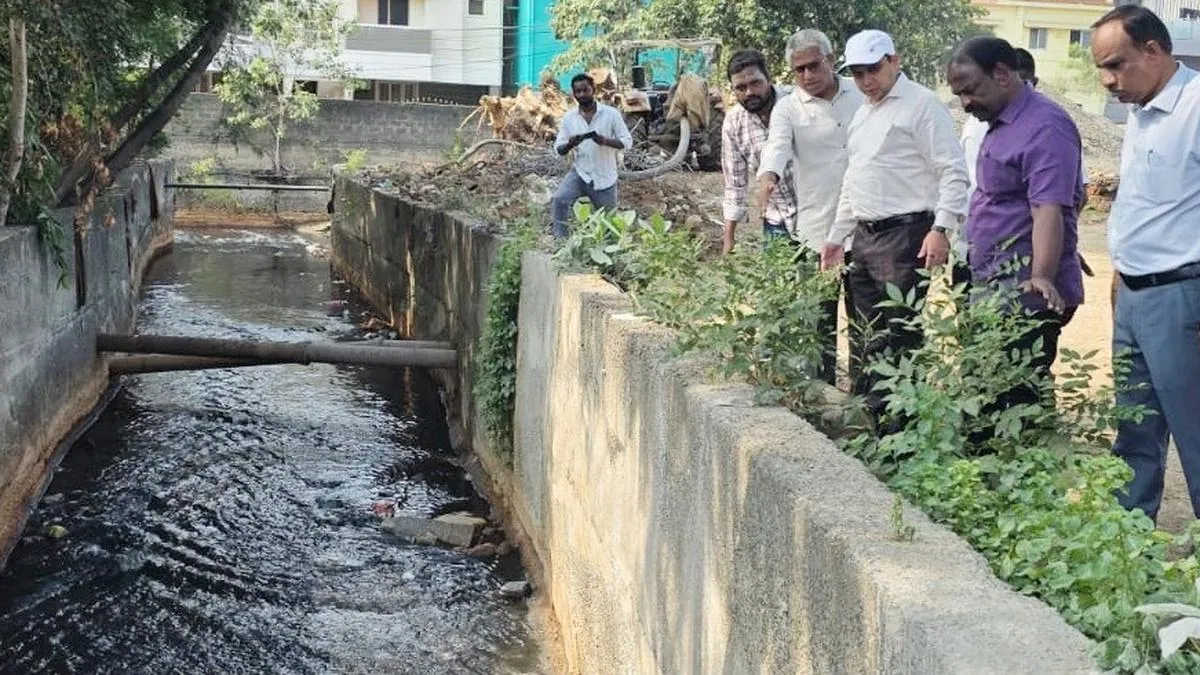
Officials in Chennai say several neighbourhoods are not fully prepared for the northeast monsoon because civic infrastructure projects remain unfinished. The city corporation is accelerating work and has outlined temporary measures for heavy rain.
At a meeting with Mayor R. Priya on Tuesday, Greater Chennai Corporation officials identified unfinished projects in Korattur, Ganesapuram, Saidapet and Parangusapuram, as well as areas along Anna Salai and Arcot Road. Deputy Mayor Mu. Magesh Kumaar said alternative arrangements had been proposed in several locations, including Besant Road, P.S. Sivasamy Salai, Saidapet Govindan Road, Ganesapuram, Perungudi and Sholinganallur.
Commissioner G.S. Sameeran said crews were building a cut-and-cover drain between East Avenue and Padi. Of the planned 2.5 kilometres, 2.1 kilometres are complete, with work on the remaining 400 metres of CTH Road expected to take another 15 days. If it is not finished by Oct. 15, the corporation plans to deploy additional heavy-duty pumps.
Two 100-horsepower pumps are planned at the Korattur signal and East Avenue Road junction. Sameeran said they would direct rainwater to the drain near the Lucas TVS front gate, then into a new drain near Park Road and onward to Otteri Nullah.
The corporation also asked the National Highways Authority of India to remove debris and temporary structures from the Cooum by Oct. 15. About 70% had been cleared at the time of the statement. A technical committee involving Chennai Metro Rail Limited engineers and officials from the corporation, Highways and Water Resources departments is coordinating work at metro sites. Its suggested measures include pumps and sumps, temporary earthen channels and changes to diaphragm walls.
The corporation said work had been carried out at 60 metro sites. Six robotic excavators, five float excavators, three amphibious excavators and 40 skid-steer loaders were used to clear culverts across 44 canals. End-to-end desilting was complete on the Kodungaiyur, Padikuppam and Trustpuram canals, and more than 85% of Otteri Nullah and over 80% of Virugambakkam Canal had been desilted.