
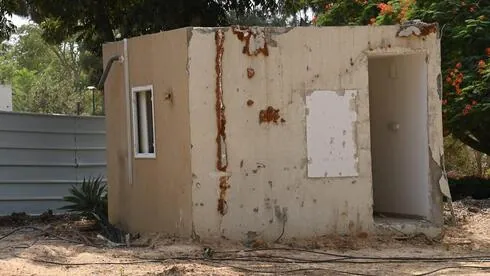
Nearly three years after the October 7 attack, about 120 people spend each night in Kibbutz Nir Oz, where six residential compounds are being built at once. Some residents are returning, others have chosen to leave permanently, and the community remains divided over whether to preserve damaged homes as memorials.
As the third anniversary of the October 7 attack approaches, Kibbutz Nir Oz is gradually restoring everyday routines. Its grocery store, dining hall and pub are operating again, and former service buildings have been adapted for new uses. A temporary store opened in the old sewing workshop, the former boiler room became a Pilates studio, and the laundry was converted into a dining hall. At the same time, six residential compounds are under construction.
About 120 people now sleep in the kibbutz each night, roughly one-third of the number who were there on the morning of October 7, 2023. Nir Oz had about 400 residents then: 65 were killed and 76 abducted. According to Ynet, attackers entered more than 90% of the homes and many buildings were badly damaged.
Construction is under way on 76 housing units, with another 106 larger units planned for the eastern part of the kibbutz. The completed project is expected to bring the total to more than 220 homes. Ami Palmor, who coordinates the rehabilitation project, says returning residents are rebuilding daily life cautiously, alongside burned homes and construction sites. Ron Bahat, responsible for physical reconstruction, estimates that about 60% of the original residents will eventually return. The kibbutz plans to gradually invite new families to fill the remaining places.
For some, returning is a way to feel at home again. Telma Atzili, whose son Aviv was killed while serving in the kibbutz rapid-response squad, returned about four months ago. She describes the move as difficult: growth and young families coexist with a pervasive sense of loss. Although she could return to an apartment elsewhere, she says she wants to remain in Nir Oz.
New homes are being designed with protection beyond Home Front Command requirements. In addition to a standard safe room, plans include a reinforced door, a protected bathroom, a larger room and electric shutters that can be operated from inside the shelter. Palmor said residents are paying for the added measures themselves. About 20 people and families have already applied to join the kibbutz. Among those moving back are Galia Tzur and Arnon Einar, who sold their home in New Zealand after deciding to help rebuild the community.
Not everyone wants to return. About 45 families chose to move to Kibbutz Beit Nir and reached an agreement for state support. According to Ynet, families seeking to separate from the community and start independent lives have not yet received a decision. Yaron Maor, who survived the attack and fought the assailants who entered his home, is seeking compensation that would allow his family to begin again. “To choose life, we have to get up and leave,” he said. Palmor said the community cannot be rebuilt if some families are left without support.
The kibbutz is also moving through a process of privatisation. The return is becoming visible in daily routines — shopping, meeting at the pub and taking Pilates classes — and the first wedding there since the attack took place recently. But more than 220 future homes do not answer the central question on their own: who will come back, who will arrive for the first time, and what kind of community can they build in a place that still bears the marks of destruction?