
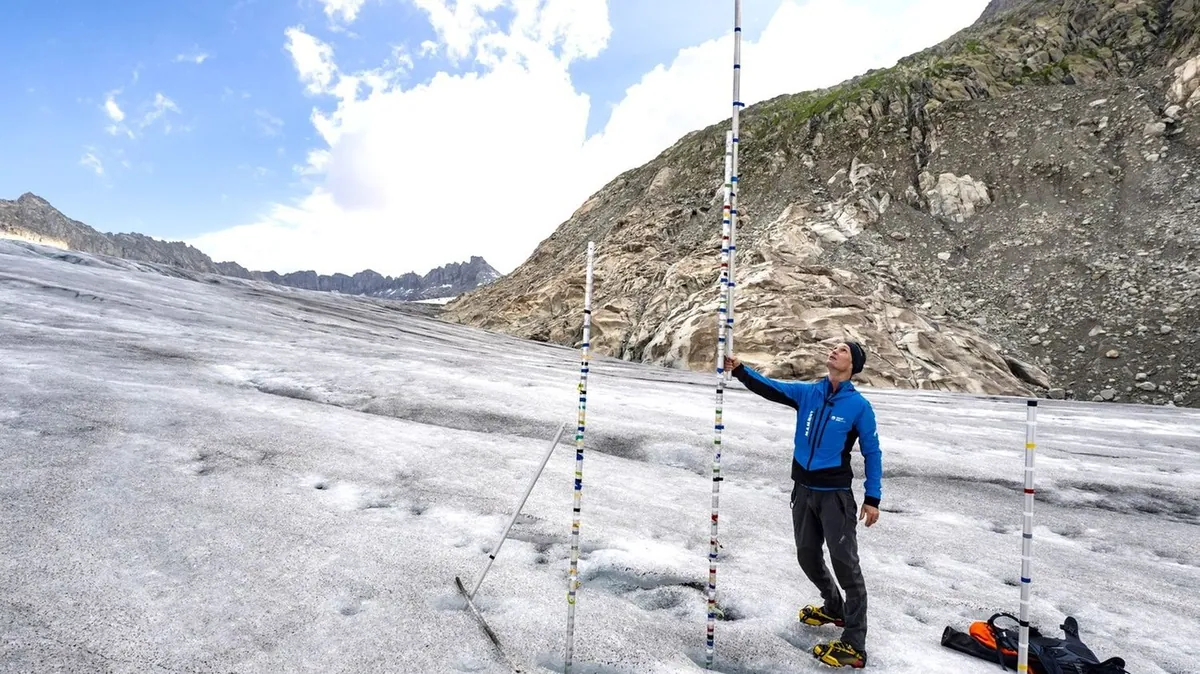
Swiss glaciers lost 5.5% of their volume in 2026 and nearly a fifth over five years. Repeated heatwaves and a low-snow winter accelerated the melt, while ice thickness fell by as much as 13 metres at one point, according to GLAMOS and the Swiss Academy of Sciences.
GLAMOS and the Swiss Academy of Sciences (SCNAT) said 2026 brought the second-largest glacier losses since records began, behind 2022. Average ice thickness fell by 2.5 to 4 metres in some areas. At the lowest monitoring point on the tongue of the Aletsch Glacier, the largest in the Alps, it declined by 13 metres. Aletsch and the Rhône Glacier recorded their most intense melt on record this year.
Heatwaves from May to September and a shortage of winter snow drove the losses. Snow cover normally shields the ice from summer heat, but in 2026 it was far below average at every elevation. The freezing level remained above 4,000 metres for 76 days between May and September, more than twice the average and a record.
By June 29, the glaciers had used up their winter snow and ice reserves and begun losing mass. Since 2000, that threshold has usually fallen in July, August or September. The only earlier date was June 26, 2022.
Glaciologist Matthias Huss estimated that at least 30 small glaciers may have disappeared this summer. The Plattalva Glacier in the canton of Glarus melted completely in September. Switzerland lost 160 glaciers between 2016 and 2023 and more than 1,000, or about 40% of its total, over the past 50 years.
For now, meltwater adds to supplies in Alpine valleys and major rivers, including the Rhine, Rhône and Danube. Glaciers lost about 2.2 trillion litres of water from July to September, more than four times the annual drinking-water use of all Swiss households. That contribution is expected to shrink as glacier area declines, potentially worsening water shortages during droughts.