
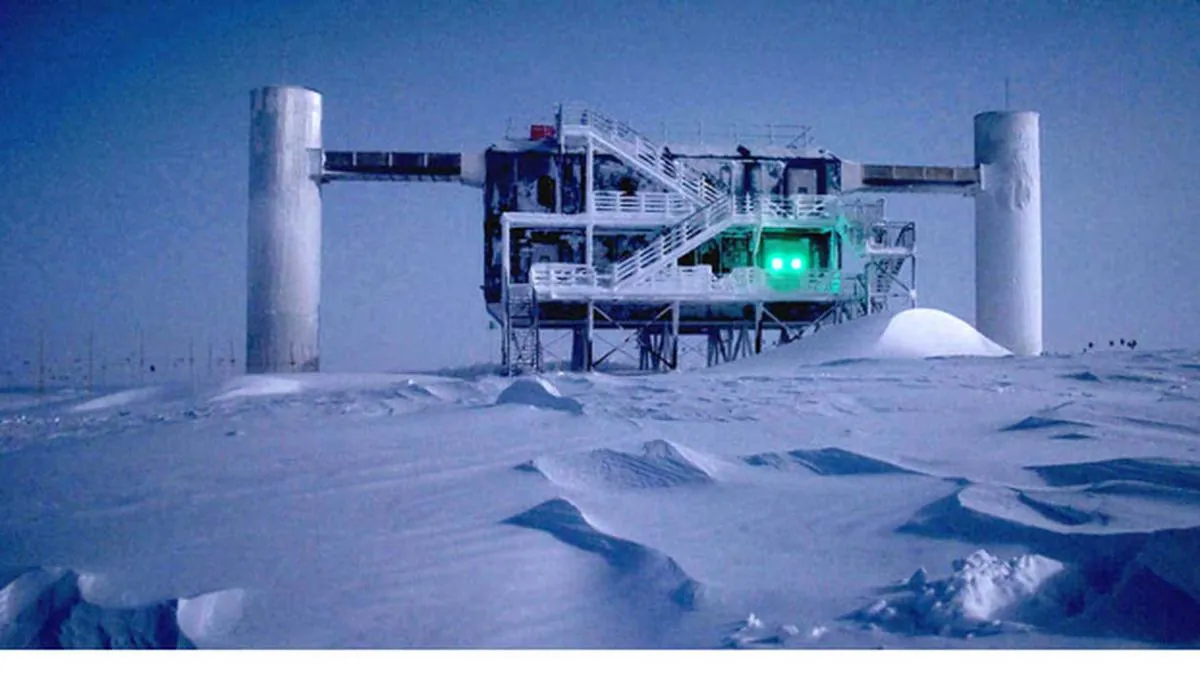
Francis Halzen won the 2026 Nobel Prize in Physics for decisive contributions to the IceCube observatory and the discovery of high-energy neutrinos of astrophysical origin.
The IceCube observatory in Antarctica detects neutrinos, particles that interact so rarely with matter that they can point back to cosmic sources of extreme energy. Belgian-born U.S. physicist Francis Halzen won the 2026 Nobel Prize in Physics for his decisive contributions to the detector and the discovery of high-energy neutrinos of astrophysical origin.
Cosmic rays reaching Earth consist mainly of protons and atomic nuclei. Some carry more energy than the Large Hadron Collider can impart to particles. Exploding stars and jets from distant galaxies are possible sources, but magnetic fields deflect charged cosmic rays, making their arrival direction an unreliable guide to where they began.
Neutrinos have no electric charge, very little mass and interact only rarely with matter. They can pass through Earth almost unnoticed while retaining a straight path from their source. IceCube turns a cubic kilometre of Antarctic ice into a detector, using 5,160 optical sensors on 86 cables placed 1.4 to 2.4 kilometres below the surface.
When a neutrino strikes an atomic nucleus in the ice, it can create charged particles. If those particles move faster than light can travel through the ice, they produce a faint blue glow known as Cherenkov radiation. The sensors record the flashes; their sequence helps researchers estimate a neutrino’s energy and direction. Most detected neutrinos come from Earth-based sources. Of roughly 100,000 registered each year above an energy threshold, about a hundred are astrophysical.
The idea of using South Pole ice to detect neutrinos developed from the late 1980s. Halzen helped organise the international effort that became IceCube, funded primarily by the U.S. National Science Foundation. The full observatory took shape in 2011 after seven years of construction. Crews drilled sensor holes with jets of hot water and lowered the instruments before the ice refroze.
In 2013, the team identified two neutrinos with about 140 times the energy of a proton accelerated by the Large Hadron Collider. Later analysis established a population of high-energy neutrinos arriving from elsewhere in the universe, a milestone for neutrino astronomy. IceCube detected a neutrino from a distant galaxy in 2017 and, in 2022, more than expected from NGC 1068.
IceCube also contributes to multi-messenger astronomy, which combines observations of light, neutrinos and gravitational waves. Researchers continue to investigate the sources of the universe’s most energetic neutrinos and compare detections with observations from other instruments. The Nobel committee recognised both the scientific vision and Halzen’s decades of leadership of an international team of scientists and engineers.