
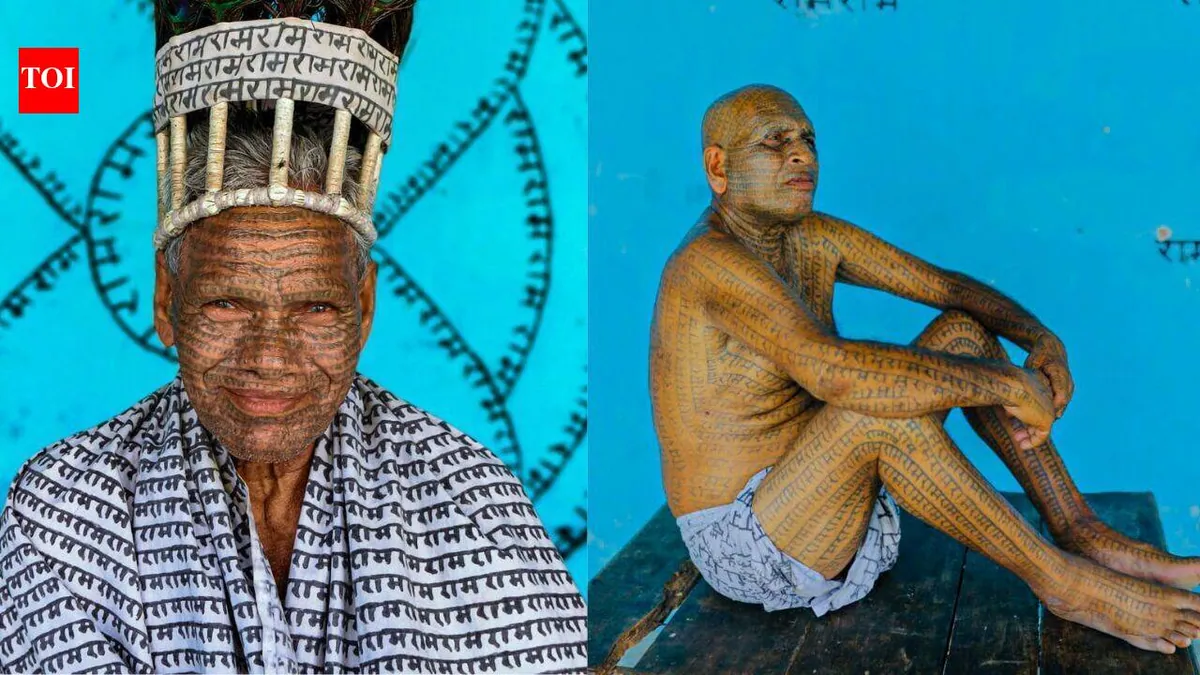
A national film award has renewed attention on the Ramnami community in central India. Its members have long tattooed the name of Ram on their skin as an expression of devotion and resistance to caste exclusion, but only a few retain extensive traditional tattoos.
The Ramnami community lives mainly in villages along the Mahanadi River in Chhattisgarh, as well as in nearby parts of Maharashtra and Odisha. For its members, the name of Ram is more than a subject of prayer: it is tattooed on the forehead, cheeks, chest, arms and legs. Gularam Ramnami, the community’s general secretary, estimates that only two people now have complete head-to-toe tattoos, while fewer than 50 retain extensive traditional markings.
Interest in the community has grown after filmmaker Bharatbala Ganapathy’s documentary “Ram-Nami” received a National Film Award. The tradition began more than a century ago, when Dalits in parts of what are now Madhya Pradesh and Chhattisgarh were barred from temples. One account says the saint Parasuram was the first to tattoo the word “Ram” on his forehead in the 1890s. Researcher Ramdas Lamb has suggested that the movement may be older, continuing the 15th-century Bhakti tradition; accounts agree that it arose in response to social exclusion.
Younger members increasingly choose smaller tattoos or none at all. That does not necessarily mean they are leaving the faith: many still attend devotional singing, wear the name of Ram on their hands, chest or forehead, and learn the community’s songs. Education, work, migration and city life influence the choice, as do concerns that visible tattoos could complicate employment. Gularam says the decision now belongs to each person and children should not be forced.
Traditionally, community members tattooed one another. The black pigment was made at home from soot collected from a ghee lamp, water and herbs. White cloth was covered with the name of Ram, and older Ramnamis wore peacock-feather crowns. The faith has no temple rituals or priesthood. Gularam describes vegetarianism, abstinence from alcohol and rejection of discrimination by caste, religion, language, colour or gender as central vows.
At the end of the harvest season, in December or January, the community gathers for a three-day bhajan festival in Sarsiwa village in Raipur district. Participants erect a pillar inscribed with the name of Ram and read the “Ramcharitmanas.”