
The ceasefire halted large-scale fighting and secured hostage and prisoner releases, but strikes continue while Hamas’s disarmament and Gaza’s reconstruction remain unresolved.
One year after Donald Trump presented a plan to end the war in Gaza, its next stages remain stalled. Israel carries out near-daily strikes and controls about two-thirds of the territory, while roughly two million Palestinians are concentrated in an increasingly narrow coastal strip. Reuters reports that the plan called for Hamas to disarm, Israeli forces to withdraw in stages and the enclave to be rebuilt.
The initial phase led to a ceasefire on Oct. 10, 2025, the release of the last hostages captured in Hamas’s 2023 attack on Israel, and the release of hundreds of Palestinian prisoners and detainees. Trump’s 20-point plan also called for increased humanitarian deliveries. Later phases were to include Hamas’s disarmament, a Palestinian administration overseen by Trump-led Board of Peace and a transfer of security to a temporary International Stabilization Force.
Gaza’s Health Ministry says at least 1,400 Palestinians have been killed since the October ceasefire, including women and children. It does not say how many were members of armed groups. Israel says it targets Hamas and accuses the group of trying to carry out attacks and rearm. Hamas denies the accusations. The Israeli military says five of its soldiers have been killed since the truce began.
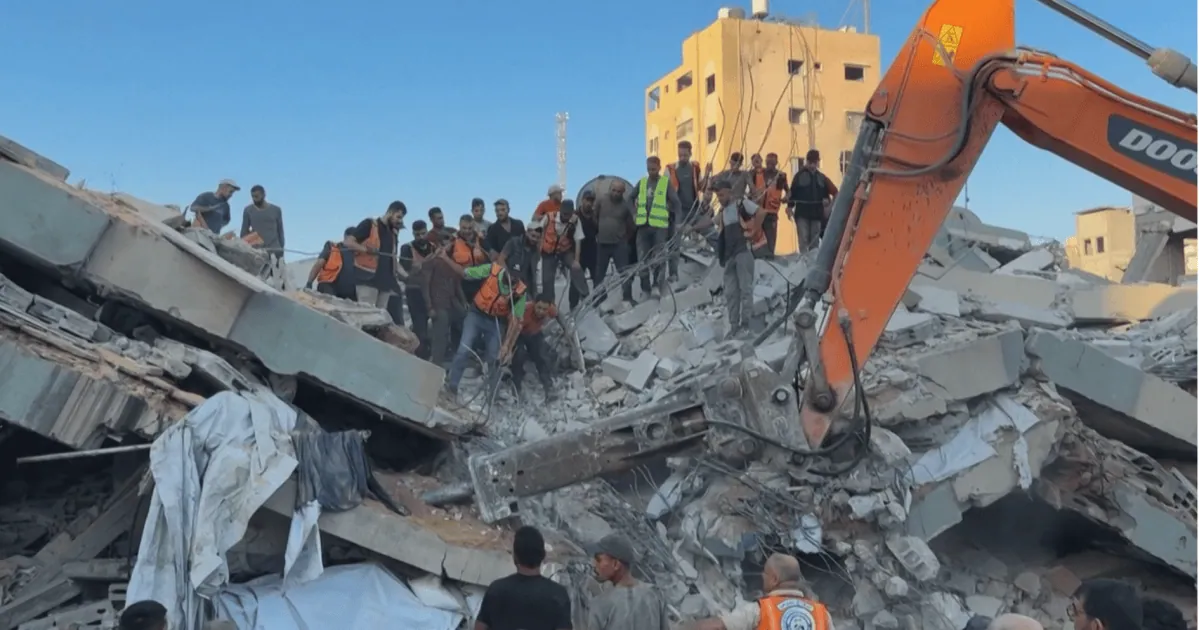
The initial “yellow line” was to leave Israel in control of 53% of Gaza, but the source says Israel’s effective control has since expanded to about two-thirds. The advance displaced more residents and crowded people into tents and damaged buildings. Humanitarian groups cite the Integrated Food Security Phase Classification (IPC), which says more than 1.2 million people still face acute food insecurity. An average of 227 trucks carrying humanitarian and commercial supplies entered Gaza daily from the start of the ceasefire through the end of May — less than half the plan’s minimum target of 600. Israel disputes that delivery estimate and says about 600 trucks enter each day; aid groups say Israel blocks essential materials.
In July, the Board of Peace presented a separate 15-point roadmap for handing over weapons. Trump said Hamas and other armed groups had accepted it. Hamas said it had agreed to place its weapons under the control of a U.S.-backed Palestinian technocratic government, while rejecting the term “disarmament.” Israel calls the proposal unacceptable and says it will not withdraw further until the group is fully disarmed.
The International Stabilization Force has not yet been assembled. U.S. Major General Jasper Jeffers has been named commander; Indonesia, Morocco, Kazakhstan, Albania, Kosovo and Uganda have pledged personnel. The long-term plan calls for a 20,000-member force and training 12,000 Palestinian police officers. The National Committee for the Administration of Gaza, led by Ali Shaath, was appointed in January but has not entered the enclave.
The Board of Peace put forward a $2.45 billion plan in September to begin reconstruction. An EU and U.N. assessment published in April estimated recovery and reconstruction needs over the next decade at $71.4 billion. Meanwhile, right-wing Israeli politicians have called for Palestinians to leave under the label of “voluntary emigration.” Defense Minister Israel Katz said last month there would be no “real solution” for Gaza without it. Israeli authorities say they have no plan to forcibly displace residents; Trump had earlier backed away from a permanent-resettlement idea that drew opposition from Arab countries and broad international rejection. Israel’s general election is set for Oct. 27, and opposition figures are divided over Trump’s plan.