
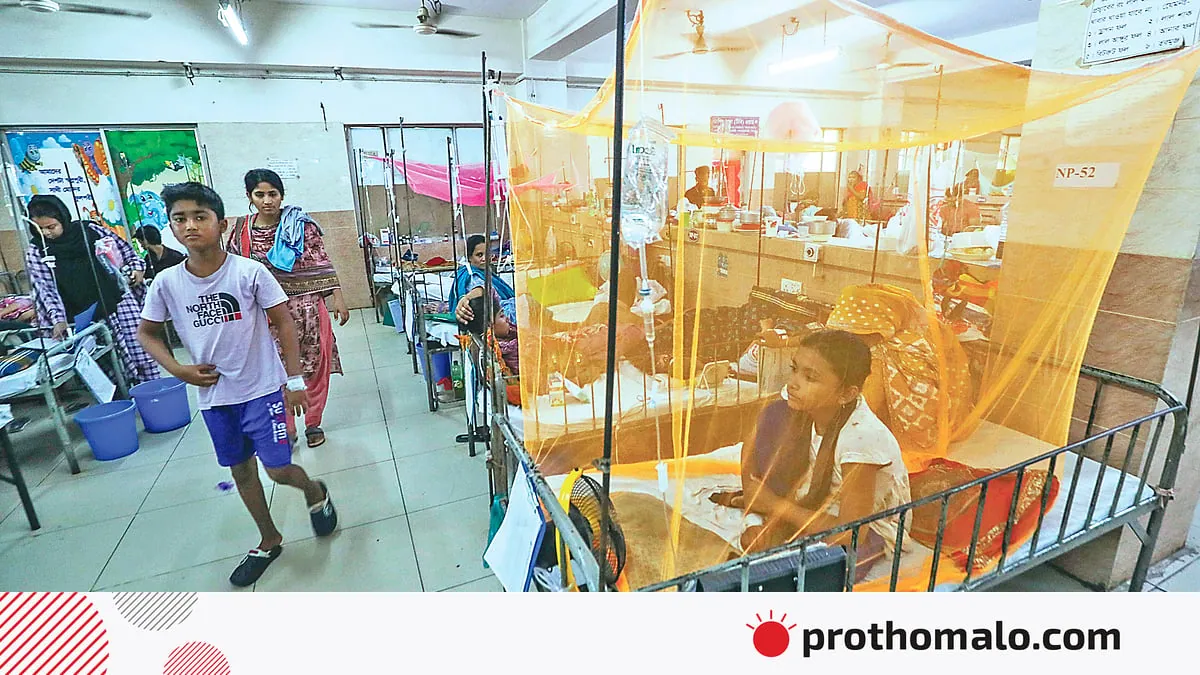
Hospitals admitted 1,996 patients in the latest 24 hours, while the annual death toll reached 281. A Prothom Alo report found that many mosquito-control committees required under national guidelines have not been formed or are inactive.
Dengue, once concentrated in major cities, has become a problem in rural Bangladesh as well. A Prothom Alo report says 1,996 people were admitted to hospitals in the latest 24 hours and 281 people have died this year. Cases have been reported in every district, while large-scale mosquito-control programmes are lacking in rural areas.
National guidelines adopted in 2019 call for dengue-prevention committees at ward, union, upazila, district, municipality, city-corporation and central-government levels. The report says many of these bodies, apart from the national committee and city-corporation committees, are effectively inactive.
A Local Government Division official told the newspaper that the national committee and committees in 13 city corporations and 330 municipalities were working; he said the other committees were surely active too. An anonymous researcher advising the government said he knew of municipal committees but not those at union or ward level. Officials in several localities told the newspaper that committees had not been formed or had not met.
The guidelines provide for 11-member committees in each of 41,391 union wards, as well as committees in 330 municipalities, 503 upazilas, 64 districts, 13 city corporations and their wards. The planned total from local to national level is 48,559 committees. The guidelines assign regular meetings, coordination among agencies, year-round prevention, clean-up work and the destruction of mosquito-breeding sites.
Conditions vary by locality. Comilla authorities said committees had been formed at several levels and in all 27 city wards. In Bera, a local administrator said he had received no instruction to form a committee, although prevention work was under way. Netrokona carries out weekly fogging but has no committee in any of its nine wards. Mymensingh has a task force, while its earlier ward committees are no longer active.
Local representatives in Keshabpur gave different accounts: one said no committee meetings had taken place, while another said the committee had met. Authorities in Taraganj bought mosquito-control chemicals and a fogging machine, but have yet to form a committee. Sylhet has no ward-level committees, and the report says none exist at local levels in Sandwip.
Prime Minister Tarique Rahman called on residents to join clean-up efforts in March and launched a nationwide campaign in September, scheduled for Saturdays through December 12. According to health-directorate figures cited in the report, annual hospital admissions reached 90,356 and 5,776 patients were in hospital at the time of publication. Public-health expert Abu Jamil Faisal urged authorities to create and activate the committees to engage residents in prevention.