
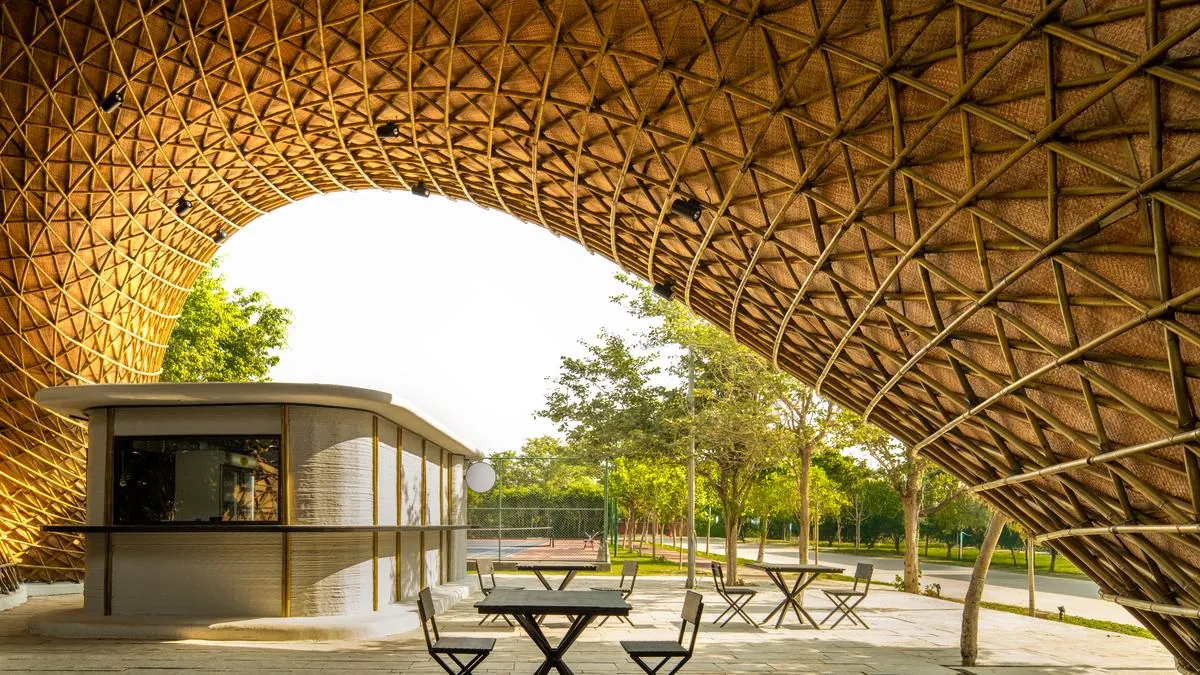
The Hungry Caterpillar, designed by Apoorva Shroff and opened in September 2025, won two architecture and design awards in 2026. Its 650-square-metre site combines bamboo canopies, modular 3D-printed concrete kitchens and recycled-plastic furniture.
Architect Apoorva Shroff conceived The Hungry Caterpillar in 2024 while designing a residence for Ashoka University founder Ashish Dhawan. For the campus food street, she imagined a cocoon beneath the tree canopy, an image she associates with safety, growth and young people’s development. The pavilion opened in September 2025.
The 650-square-metre project treats the food street as a shared environment rather than a row of food outlets. Jans Bamboo made the lightweight bamboo gridshell canopies, with structural design by Atelier One. Their folded-leaf geometry is intended to sit closely within the surrounding landscape.
The kitchens are modular units made from 3D-printed concrete, which Shroff describes as a way to reduce construction waste and improve efficiency. Placyle supplied furniture made from recycled plastic. Crushed-bamboo mats provide shade and passive cooling.
Shroff said the design required working with bamboo’s structural behaviour rather than treating it simply as a substitute for steel. She studied bamboo construction in Bali, an experience that informed the project. A team from several cities worked on it, while conversations with the university community helped shape spaces where students, faculty and visitors can meet.
The Hungry Caterpillar received a Blue Elephant Award at the 2026 Kyoorius Design Awards and a Platinum award at the 2026 International Architecture and Design Awards. The project aims to combine a distinctive form and practical use with more careful material choices and a comfortable public setting.