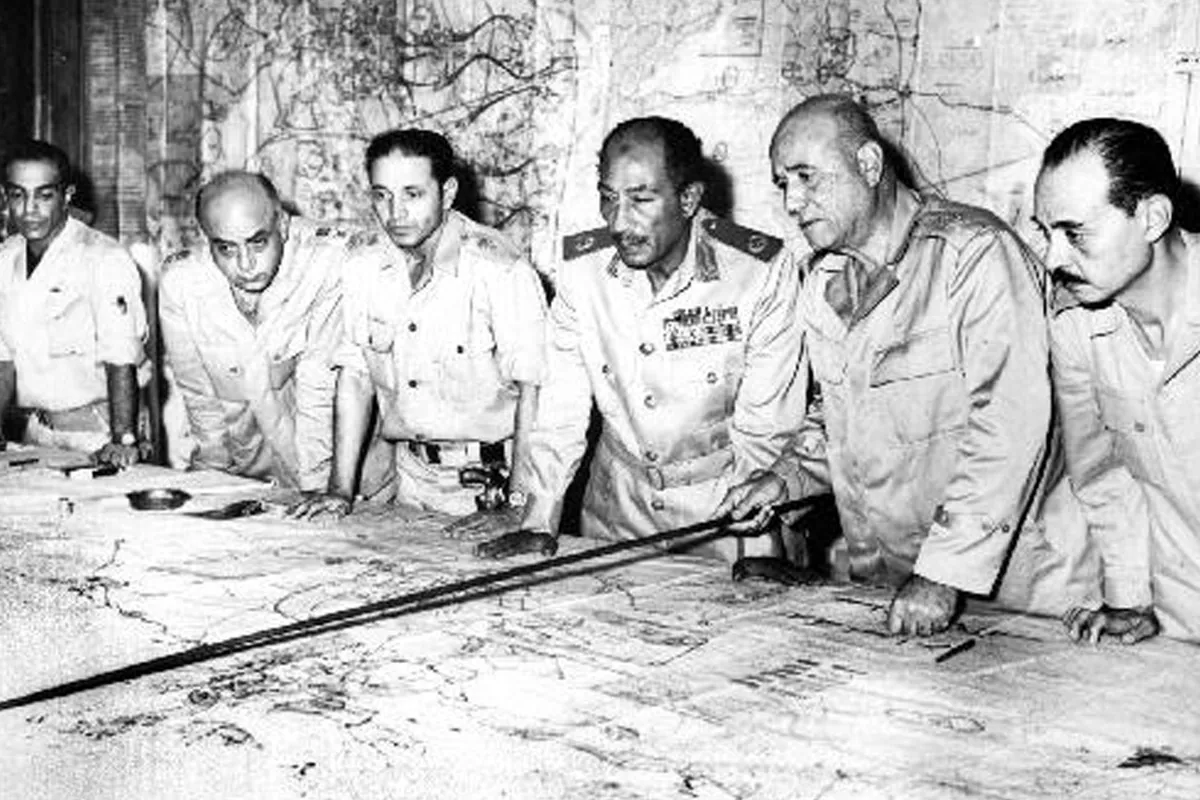
The October 14 drive toward Sinai’s strategic passes ended with heavy losses and failed to meet its objectives. Egyptian commanders later disagreed over whether it was part of the plan or a political decision, reflecting competing ideas about the war’s scope.
After crossing the Suez Canal on October 6, 1973, Egyptian forces established bridgeheads under air-defence cover and held a narrow strip of Sinai. On October 14, the command tried to push toward the strategic Gidi and Mitla passes. The offensive advanced along four axes but was poorly coordinated: units moved beyond the air-defence umbrella, met prepared Israeli positions and did not receive the support they requested.
The 21st Armoured Division carried the main effort around Tasa. Its commanders had little time to prepare, and commanders of forward units were killed in the opening phase as communications broke down. In the south, the 3rd Armoured Brigade advanced nearly 25 kilometres east of the canal but became isolated, came under air attack and lost its commander, Nour el-Din Abdel Aziz. In the north, the 15th Brigade was stopped at Israeli positions. The 11th Mechanized Brigade’s attack also faltered after a delay in passing orders and was later cancelled.
Tank-loss estimates vary according to which units and time period are counted. Al Jazeera cites a U.S. Army study estimating about 200 Egyptian tanks lost in the attempted breakthrough and 188 losses for the 21st Division among the 200–210 tanks in its forward brigades. A separate U.S. Army history says the division had 136 tanks by the end of October 14, down from a prewar strength of 280. The figures use different baselines and should not be treated as the same count.
After the failed offensive, Israel intensified operations near the gap between Egypt’s Second and Third Armies at Deversoir, crossed to the canal’s west bank and threatened to encircle the Third Field Army. The meaning of the October 14 attack and its place in Egypt’s war plan remain disputed. Chief of staff Saad el-Shazly considered an advance beyond missile protection too risky and argued it was not a mandatory stage of the original concept. Field Marshal Mohamed Abdel Ghani el-Gamasy, by contrast, said an advance toward the passes was part of the broader plan.
The disagreement also reflects different meanings of “plan.” Shazly’s account describes the basic operation as a canal crossing, a 10-to-15-kilometre advance and a defence under Egyptian missile cover. A broader written plan may have included a second phase toward the passes after an operational pause, but that did not necessarily mean it had to be launched automatically. In Shazly’s telling, the option depended on how the battle developed; commanders of the Second and Third Armies objected, warning that Israel could exploit its air and armour superiority.
Other participants and historians disputed details in Shazly’s and Fawzi’s accounts of Plans 200 and Granite. General Mohamed Fawzi described a phased concept to liberate Sinai, while military historian Gamal Hammad said documents cited by Fawzi did not support some of his conclusions. Historians therefore distinguish the initial defensive concept, options for a later advance and the specific decision taken in October 1973.
Al Jazeera’s article connects the military debate to broader questions about the war’s aims and the peace settlement that followed. That is the author’s interpretation of the campaign’s political significance: military results, diplomatic decisions and the Palestinian issue are treated as connected but contested subjects. The battle of October 14 itself does not provide a definitive answer about the Egyptian leadership’s original intentions.