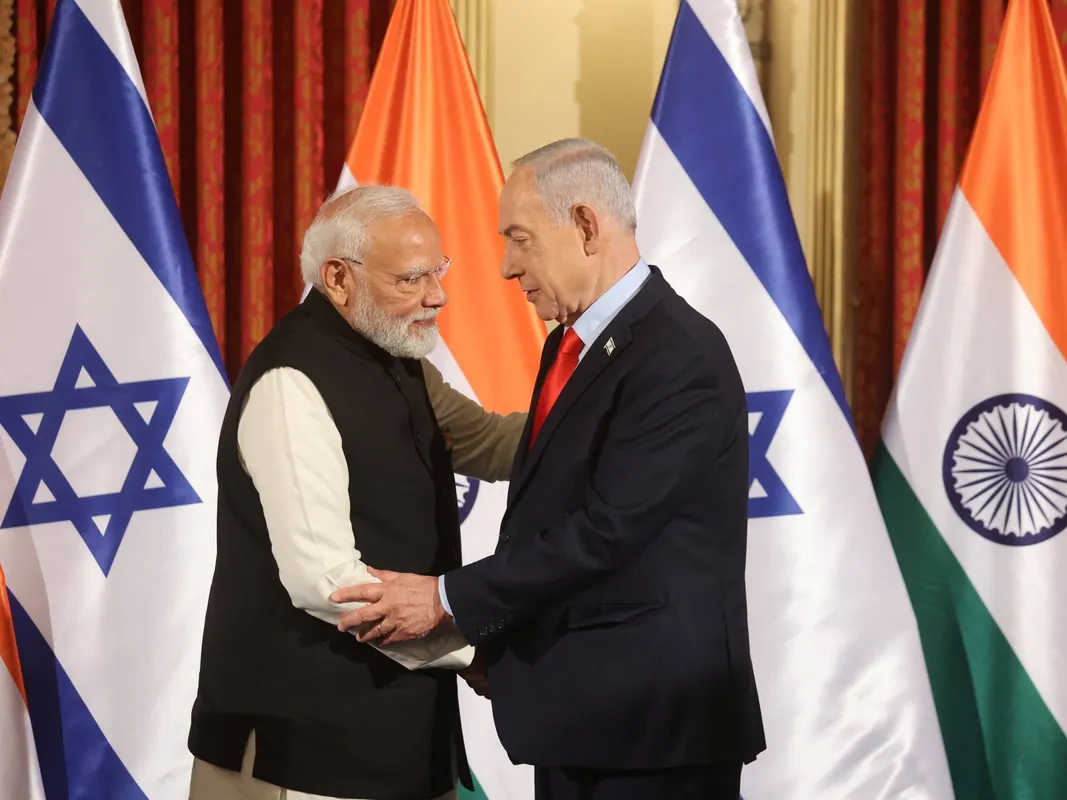
India has deepened its ties with Israel under Prime Minister Narendra Modi, after decades of support for the Palestinian cause. Analysts link the closer relationship to defence interests, domestic political rhetoric and a changing international landscape.
Modi visited Israel in February, where Benjamin Netanyahu called him a “great friend” and “brother.” The visit came amid the Gaza war and growing international criticism of the Israeli government. Al Jazeera reported that Indian arms exports to Israel continued during the war, and that India had become one of Israel’s largest arms buyers. SIPRI data also identify India as Israel’s largest export market in 2023.
The shift began earlier. After Modi and his Bharatiya Janata Party came to power in 2014, cooperation with Israel became more public. In 2016, Modi became the first Indian prime minister to visit Israel. The two countries established diplomatic relations in 1992.
New Delhi analyst Rashid Kidwai says the BJP’s rhetoric about “Islamic terrorism” connects its foreign policy with domestic politics. He said portraying Israel as a country under attack helped Modi justify closer ties. Former Indian diplomat Navdeep Suri points to defence and intelligence cooperation as well as stronger people-to-people links.
India historically supported the Palestinians. It backed a 1975 UN resolution describing Zionism as a form of racism, became the first non-Arab country to recognize the Palestine Liberation Organization and was among the first to recognize Palestinian statehood. Suri told Al Jazeera that New Delhi could take a more principled position on Gaza and the West Bank. At least 11 European countries and Canada have introduced trade measures targeting goods from Israeli settlements, while some governments have sanctioned settlers and Israeli ministers.