
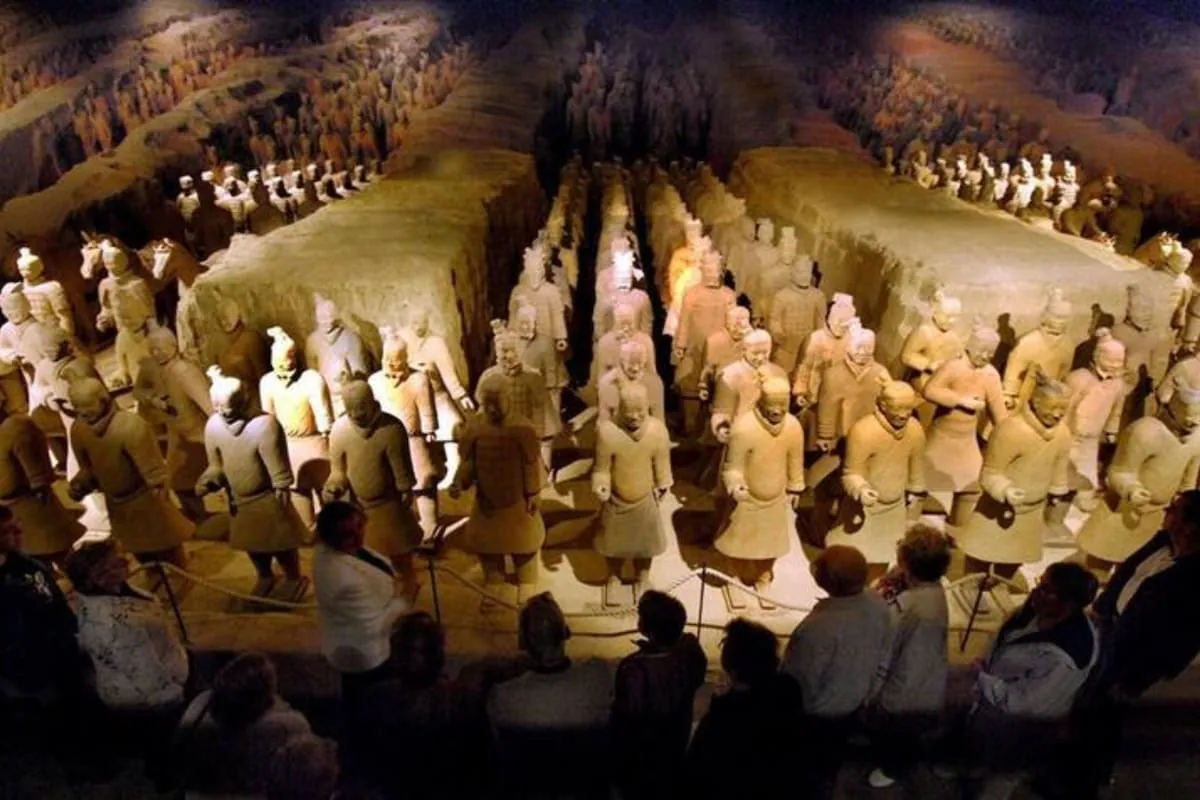
In 1974, farmers digging a well in China’s Shaanxi province found fragments of clay figures. The discovery led archaeologists to one of ancient China’s largest burial complexes: the terracotta warriors made for the tomb of Qin Shi Huang, the country’s first emperor.
In April 1974, a group of farmers in Xiyang village near Xi’an was searching for water during a drought. About a metre below the surface, they came across hard reddish soil, fragments of ceramic heads and bronze arrowheads. Local archaeologist Zhao Kangmin was called to inspect the finds. He recognised that they were not ordinary fragments and began restoring the figures.
The excavation revealed the Terracotta Army, created more than 2,000 years ago for the mausoleum of Qin Shi Huang, the first emperor of a unified China. The complex includes thousands of life-size warriors, along with horses and chariots. A commonly cited estimate is about 8,000 figures, although the precise number of buried statues remains an estimate.
The first restored warriors helped persuade authorities to support a larger excavation. Archaeologists uncovered several underground pits containing figures, and a museum later opened near the site. In 1987, the mausoleum of Qin Shi Huang, together with the Terracotta Army, was added to the UNESCO World Heritage List.
Researchers consider the statues part of an extensive burial complex intended to accompany the emperor into the afterlife. The figures were assembled from components and finished by hand; excavations have also revealed traces of their original paint, which deteriorates quickly when exposed to air.
The emperor’s main tomb remains unopened. Ancient accounts described rivers of mercury, and soil analysis around the mound has found elevated levels of the metal. This is one factor complicating research on the burial chamber, although claims that opening it would inevitably cause an explosion are not supported by the available material.
The discovery began with an everyday effort to find water but led to a long archaeological investigation. Farmers uncovered the first fragments, and archaeologists established their connection to the mausoleum and restored some of the figures now known as the Terracotta Army.