
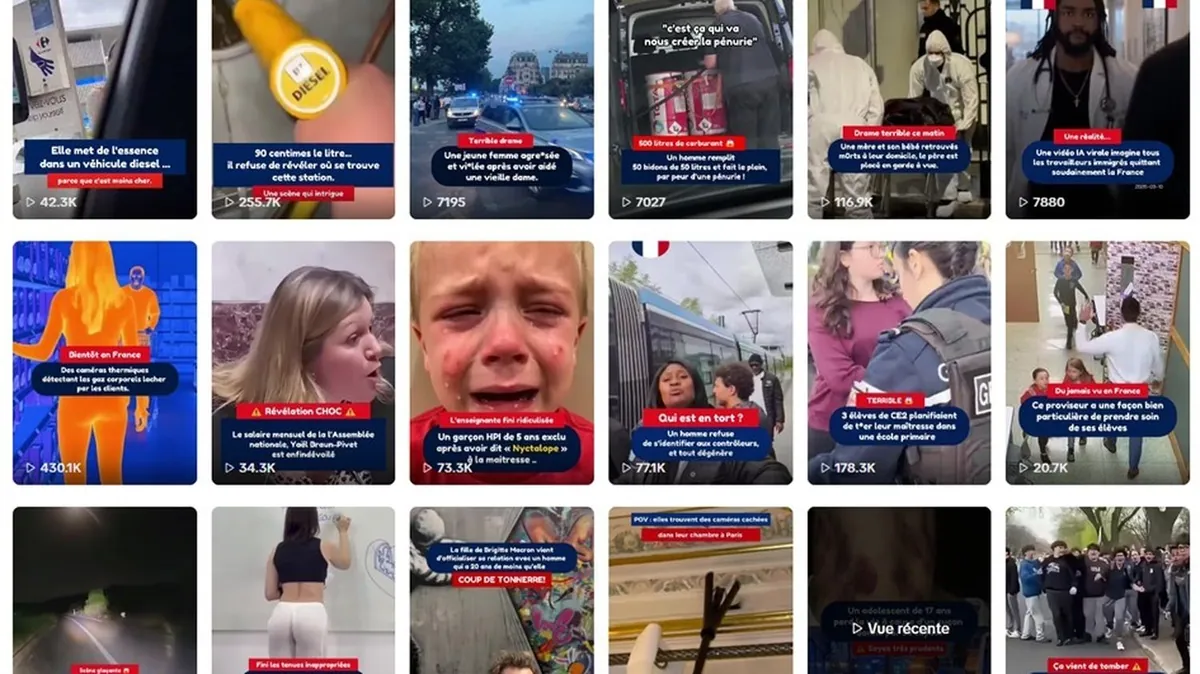
Franceinfo spoke with creators who use fabrication, distorted context and provocation to grow their reach. SIMODS research found a high share of misleading posts in its TikTok sample.
A TikTok creator identified by Franceinfo as Jean says he invents stories for football videos and earns money from several accounts. For political clips, he says, he tries to preserve “a kernel of truth,” but may use other people’s footage out of context, exaggerate events and combine clips with an AI-generated presenter.
Jean, a 29-year-old hotel receptionist, runs three accounts: two about Olympique de Marseille and Lens, and a third about politics. Franceinfo reports that they have tens of thousands of followers and that he can make a video in a few dozen minutes. In a recent clip, he staged an imagined conversation between a Qatari prince and Marseille owner Frank McCourt.
Jean says all his accounts together can bring in between 1,000 and 5,000 euros a month. He links their reach to audience reactions: comments increase a post’s visibility and view count, while views are one factor in creator payments.
Franceinfo also interviewed Teyo, a 19-year-old creator who teaches users how to monetise content. He said he had deliberately misstated a motorbike’s horsepower to prompt viewers to correct him. Other creators use material intended to trigger anger or indignation. Even a critical comment can increase a video’s reach.
The outlet places the interviews alongside research by Science Feedback under the European SIMODS project. In the second wave, published in March, about one quarter of the news-related posts encountered by TikTok users in the sample contained false or misleading information. The shares were about 15% for Facebook, 12% for YouTube, 11% for X, 8% for Instagram and 1% for LinkedIn. Researchers also found that low-credibility accounts often received more interactions than credible sources with comparable audiences.
Franceinfo reports that YouTube removed more than 2.1 million channels in the first quarter of 2026, including about 1.65 million for spam, deceptive practices and scams and nearly 154,000 for disinformation. Yet in the Science Feedback sample, 81% of channels that regularly shared misleading information and met the study’s eligibility criteria were still monetised in March 2026.
The interviewees say provocative content can quickly attract views, while lasting audience growth depends on quality and trust. Jean says he hopes to make social media his full-time job within a year or two.