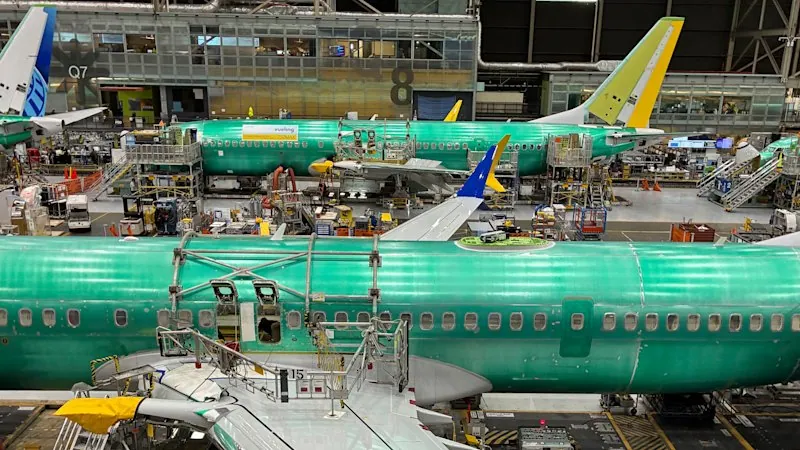
At Boeing’s Renton plant, 737 fuselages arrive by rail from Kansas and move through a production sequence that combines decades-old scale with continuing scrutiny of the aircraft’s quality and safety.
The Boeing 737 has remained in continuous production since 1967, with more than 12,000 aircraft sold. At the company’s Renton factory in Washington state, each new jet takes shape through a sequence of assembly stations that begins with a fuselage arriving by train from Kansas. Renton has built the aircraft since 1970.
The fuselages arrive in green protective primer and are lifted to an elevated inspection area. Workers add insulation and install electrical, hydraulic and mechanical systems before the fuselage moves through the first three “flow days,” Boeing’s term for production stations. The stages are not fixed 24-hour shifts. The schedule leaves room for minor delays and changes.
Those early stations involve about 70 kilometres of wiring, hydraulic tubing, flight-control cables, the dorsal fin and cockpit controls. Workers also fit a protective cover over the radar at the nose. The fuselages travel three abreast before a ceiling-mounted crane lowers them to the factory floor on the fourth day. They are then routed along three parallel lines: West, Central and East.
On that fourth day, the aircraft receives its wings, horizontal and vertical stabilisers, and landing gear. Once supported on its own wheels, it proceeds to installation of toilets, galleys and tanks for fresh and waste water. Side walls, overhead bins and forward galleys follow the next day.
Carpeting and passenger seats are fitted on day eight. A conveyor-like machine lifts seats through the cabin door three at a time, where technicians install them. On day nine, engines are mounted and connected to the aircraft’s electrical and hydraulic systems.
The Renton plant operates around the clock for most of the year, closing for Christmas and the US Thanksgiving holiday. Boeing has added production capacity elsewhere: a North Line opened this year in Everett, Washington, to build 737 MAX-family aircraft. The company has cited a backlog of 4,300 orders.
Airlines continue to seek the MAX, in part because Boeing says it uses 20 per cent less fuel than earlier 737 versions. Boeing also claims average operating costs are 7 per cent lower and maintenance costs up to 14 per cent lower than those of its competitor. Those comparisons sit against the programme’s safety record. Crashes of two 737 MAX 8 jets in 2018 and 2019 led to a global grounding and direct US Federal Aviation Administration oversight of production. The aircraft remains central to commercial aviation, while its quality-control process continues to draw close scrutiny.