
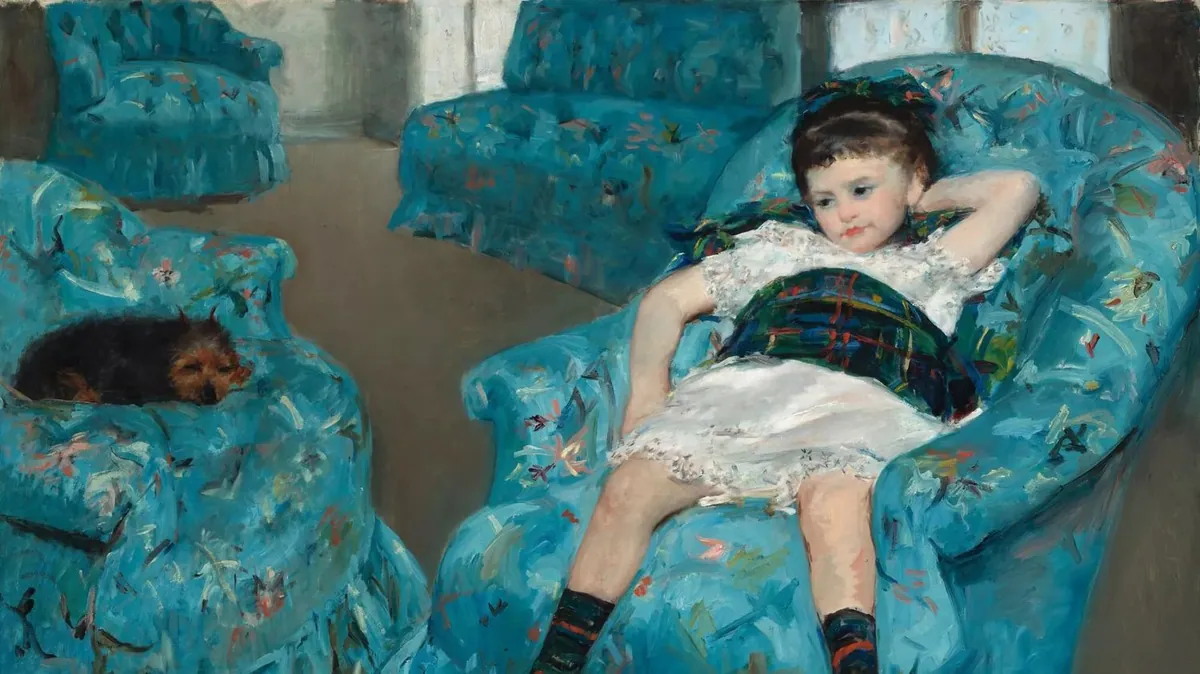
The Musée d’Orsay has opened “Mary Cassatt: Being Independent,” a retrospective marking the centenary of the American artist’s death. More than 80 paintings, pastels and prints trace her treatment of women’s independence, daily life and motherhood.
The Musée d’Orsay has opened a retrospective of Mary Cassatt, on view through January 31, 2027. The exhibition marks the centenary of the artist’s death and is the first major retrospective devoted to her by a French national museum. More than 80 paintings, pastels and prints have been assembled with London’s National Portrait Gallery and the Museum of Fine Arts, Boston; some works are rarely shown.
Cassatt was born in Pennsylvania in 1844 but lived in France for nearly six decades. In the United States she is regarded as one of the leading women painters, while she remains less familiar to the French public. Curators have drawn on previously unstudied material, especially the artist’s letters, to present not only her well-known depictions of mothers and children but also her independence, interest in women’s everyday lives and engagement with social change.
Mother About to Wash Her Sleepy Child, painted in 1880, opens the exhibition’s section on motherhood. Cassatt captures a toddler’s natural posture and turns the traditional mother-and-child theme into an everyday scene. From 1874 she worked in her own Paris studio, using models and nurses to study the human figure. Edgar Degas invited her to exhibit with the Impressionists in 1877; at the group’s fourth exhibition, Cassatt showed 12 works.
In Woman in a Loge (1879), the subject looks confidently toward the viewer from a theatre box. Cassatt’s unusual framing presents the woman not as a passive part of the setting but as an independent participant in urban life. The composition drew ridicule at the time, but the collector Alexis Rouart bought the painting. Curator Anne Robbins sees it as an image of women’s emancipation.
In The Tea, painted around 1880, two women converse in a domestic setting. An X-ray examination prepared for the exhibition showed that Cassatt repeatedly changed the placement of the tea service and removed a plate of biscuits. The curators say the artist gave the objects as much attention as the figures and used a cup to capture a fleeting gesture.
In The Carriage (1881), Cassatt’s sister Lydia holds the reins, with a young girl beside her. The painting continues the exhibition’s theme of independence. Cassatt boldly cropped the horse at the edge of the canvas. The coachman sits behind the driver, as was customary in this kind of carriage. The work has often been read as an assertion of women’s determination.
For the 1893 World’s Columbian Exposition in Chicago, Cassatt created the monumental mural Modern Woman, 18 metres wide and about four metres high. The original has not survived, so the exhibition shows a digital reconstruction based on old photographs. The central panel depicts women gathering fruit and passing it on to the next generation; the side panels show women pursuing fame and women musicians.
The exhibition concludes with Cassatt’s prints. She supported women’s suffrage and took part in a New York exhibition to raise funds for the movement. Her colour prints were innovative and technically accomplished; the painter and printmaker Camille Pissarro praised her skill. Mary Cassatt: Being Independent is open at the Musée d’Orsay Tuesday through Sunday. Admission is €14, or €10 at the reduced rate; visitors under 18 enter free.