
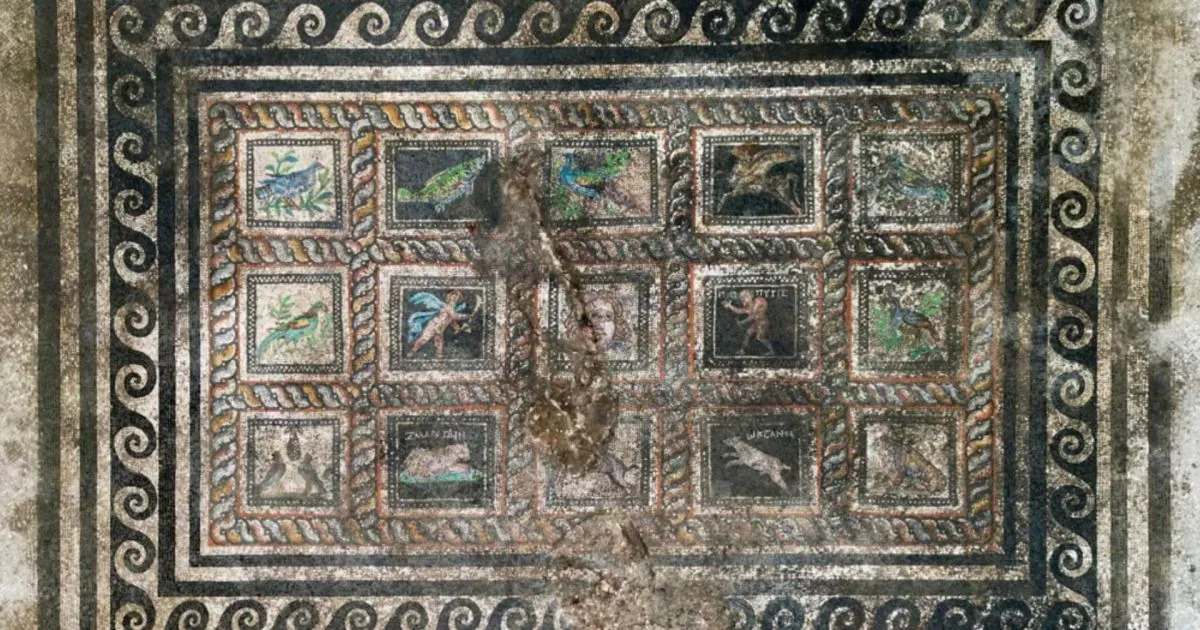
A roughly 1,800-year-old mosaic uncovered in a Roman residence in ancient Adramytteion contains 15 panels. Only the cat and dog are identified by name.
Archaeologists have uncovered a Roman residence in Adramytteion, an ancient city in present-day Türkiye, with a mosaic floor dating from the late second or third century AD. One mosaic, measuring about 5 by 3.6 metres, preserves 15 panels featuring animals and mythological figures.
Two images near the entrance stand out. One shows a light-coloured cat resting on a cushion; a Greek inscription gives its name as Zmaragdin, associated with “emerald.” Beside it is a dog depicted in motion, named Okeanos, associated with “ocean.” They are the only animals on the mosaic identified by name.
According to excavation leader Hüseyin Murat Özgen, the cat and dog may have been familiar to the household and kept as companions, though their relationship to the residents cannot be established. The mosaic also includes birds, fish, other animals and mythological figures, including a gorgon, possibly Medusa, and a winged horse.
The residence was arranged around an atrium and had three mosaic-floored halls, as well as water-circulation and drainage systems. The room containing the animal images was probably used to receive visitors. Researchers do not know who lived there or why those names were chosen. Any connection between Okeanos and Adramytteion’s location on the Aegean coast remains unconfirmed.