
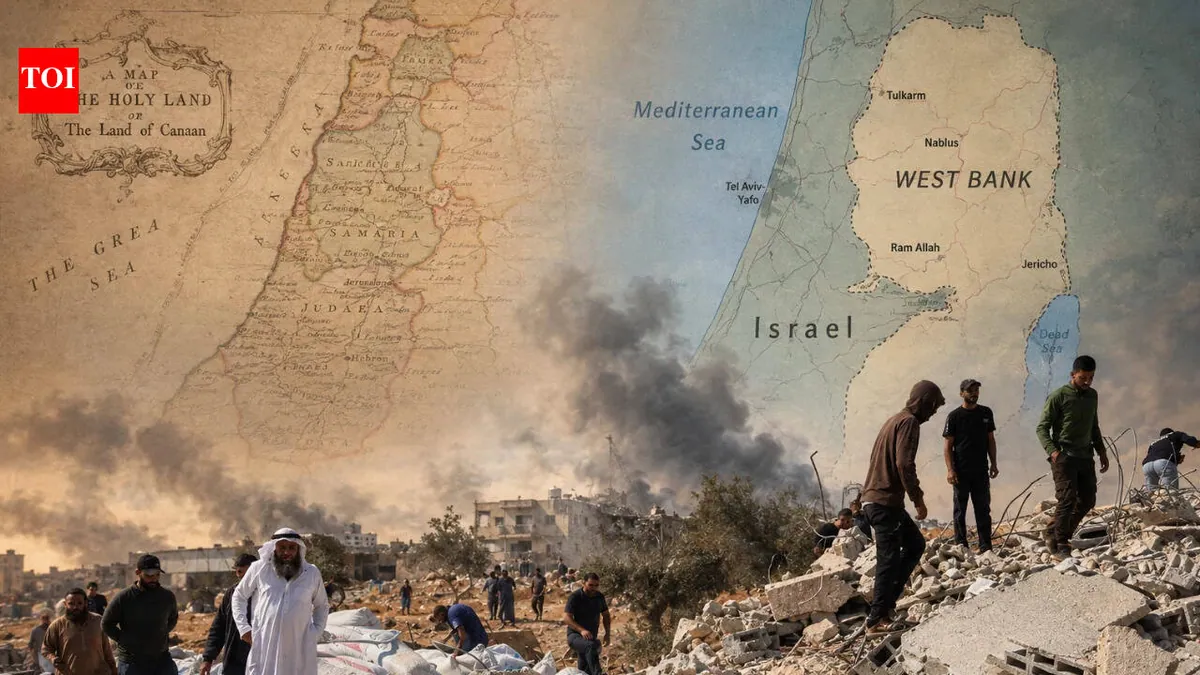
Three years after the October 7 attack and the ensuing war in Gaza, the conflict remains unresolved. Its roots include competing national movements, the 1947 partition proposal, Israel’s creation and Palestinian displacement.
On October 7, 2023, Hamas and other Palestinian armed groups launched a large-scale attack on Israel. The United Nations secretary-general says more than 1,200 people were killed and 251 were taken hostage. Israel responded with a military campaign in Gaza. Three years later, the date remains a turning point, but it does not explain the entire conflict.
One historical source of the dispute is the different national and religious connections to the land. In the biblical account, God promises Abraham the land of Canaan, an ancient region that included parts of present-day Israel and the Palestinian territories. Abraham is important in Judaism, Christianity and Islam. But an ancient religious tradition and a modern state are different things. The State of Israel was established in 1948.
By the late 19th century, the Jewish connection to the land had taken a modern political form in Zionism, a movement for Jewish national self-determination and a homeland. It emerged amid antisemitism and persecution in Europe. Palestine was not empty: it had a predominantly Arab population, including Muslims and Christians, as well as a longstanding Jewish community. As immigration grew, two national movements sought self-determination in the same territory.
In 1917, Britain issued the Balfour Declaration, supporting the establishment in Palestine of a national home for the Jewish people. It also said that the civil and religious rights of non-Jewish communities should not be harmed. After World War I, Britain governed Palestine under a League of Nations mandate. Rising immigration and growing tensions between Jewish and Arab communities led to further violence.
In 1947, the United Nations proposed partitioning the territory into Jewish and Arab states, with Jerusalem under an international regime. Jewish leaders accepted the plan, while Palestinian Arab leaders and neighboring Arab states rejected it. After Israel declared independence on May 14, 1948, war broke out with neighboring Arab states. The Arab Palestinian state envisaged by the plan was never established.
More than half of the Palestinian Arab population fled or was expelled during the war. Palestinians call this mass displacement the Nakba, or catastrophe. Many Palestinians and their descendants continue to seek the right to return to their homes and compensation for lost property. Self-determination and statehood became central demands of the Palestinian national movement.
In 1967, Israel captured the West Bank, East Jerusalem and Gaza, along with other territories. Palestinians regard the West Bank and Gaza as the basis for an independent state and include East Jerusalem in their national and religious claims. Israeli settlements established in occupied territories remain among the most contentious issues in negotiations. The United Nations refers to the West Bank, including East Jerusalem, as occupied Palestinian territory.
Before the 2023 attack, the region had experienced the wars of 1948, 1967 and 1973, two Palestinian uprisings known as intifadas, the Oslo peace process, the split between Hamas and the Palestinian Authority, and repeated rounds of fighting. Borders, settlements, Jerusalem, Palestinian refugees and the creation of a Palestinian state remained unresolved.
Religious history helps explain the land’s deep significance to different communities, but it does not reduce the current conflict to faith. Nationalism, European antisemitism, immigration, the British Mandate, the Holocaust, Israel’s creation and Palestinian displacement have all shaped it. The historical context begins well before Israel and Palestine emerged as modern political entities.