
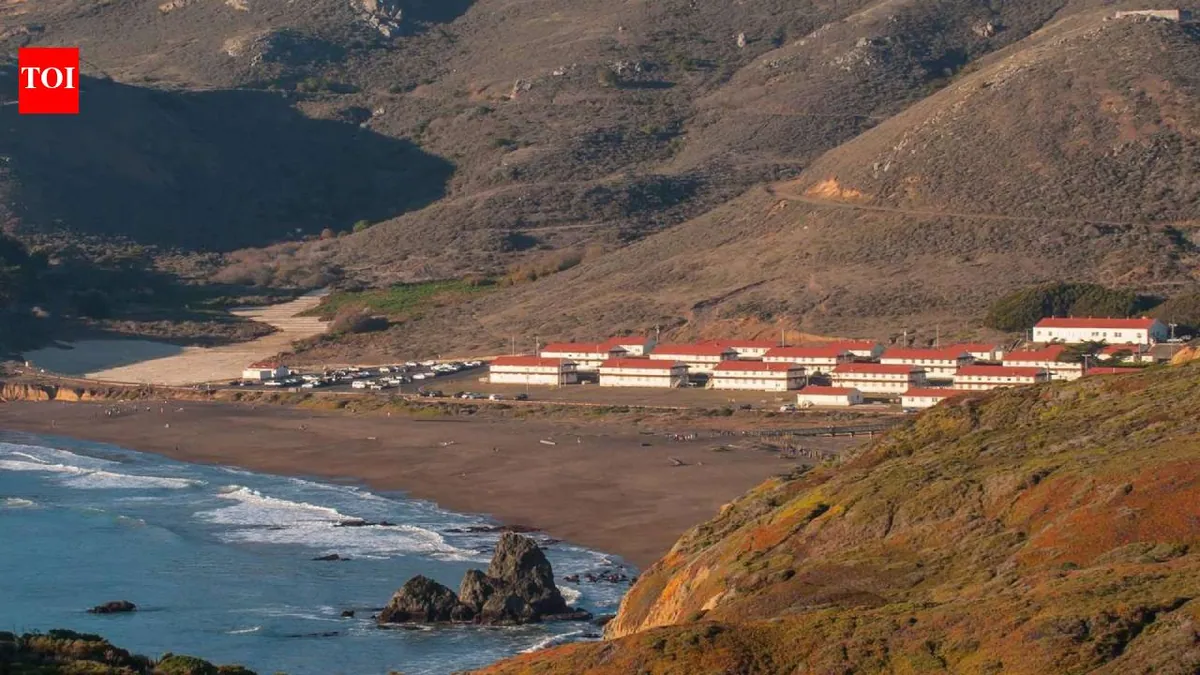
The former military post preserves World War II barracks and coastal defenses beside beaches, a lagoon and wildlife habitat.
Fort Cronkhite, in California’s Marin Headlands about 10 miles north of downtown San Francisco, began as part of the United States’ rapid military expansion before and during World War II. The post was built to house troops and support the defense of San Francisco Bay. It is now part of the Golden Gate National Recreation Area, where surviving military buildings and coastal landscapes share the same parkland.
The growth in the US Army created a need for barracks, hospitals, offices and mess halls. The source report says enlistment rose from about 200,000 in 1939 to roughly six million by 1944, and that more than 100,000 temporary buildings were constructed nationwide. Fort Cronkhite was among the mobilization posts built during that period. Many comparable sites were dismantled after the war; several barracks and other structures remain at Cronkhite.
Above the post, Battery Townsley housed two 16-inch coastal guns intended to defend the entrance to San Francisco Bay. The National Park Service says the battery was completed in 1940 and that its guns could fire projectiles weighing about 2,100 pounds. The original guns were removed after the war, but visitors can see the restored battery interior during public hours. The test firing in 1940 was so powerful that residents in San Francisco reported broken windows, according to National Park Service historical accounts.
The area’s defenses changed during the Cold War, when concern shifted toward aircraft. The nearby SF-88 site at Fort Barry was part of the Nike missile network. Together, the gun battery and missile installation illustrate how the military’s approach to protecting the Bay changed over several decades. Fort Cronkhite’s restored barracks and the National Park Service’s self-guided History Walk offer context on the wartime post.
The landscape is also a draw. Rodeo Beach lies below the fort and is known for red and green pebbles, including jasper, carnelian and jade. Strong surf and currents make swimming dangerous. Rodeo Lagoon, nearby, is a protected habitat where visitors can walk the loop trail and watch birds, but swimming is prohibited.
Trails cross the Marin Headlands, including a steep Coastal Trail section leading toward Battery Townsley. Spring wildflowers attract birds and butterflies; peregrine falcons and red-tailed hawks are among the species seen in the area. Humpback and gray whales may sometimes be spotted offshore. Coastal fog and strong winds can make conditions colder than in San Francisco.
The Marine Mammal Center, a rehabilitation and research facility, is also located near Fort Cronkhite. It cares for sea lions, sea otters, harbor seals and elephant seals. The source report says visits should be reserved in advance. Further along the coast, the Bird Island overlook is a roosting place for brown pelicans, and Point Bonita Lighthouse can be reached on foot, subject to its limited trail schedule.
Visitors reach the site by crossing the Golden Gate Bridge and following Bunker Road. Parking is limited, and there is no camping at Fort Cronkhite itself, though several tent-only campgrounds are located in the Marin Headlands. The combination of preserved barracks, historic coastal defenses, trails and Pacific shoreline makes the former post a compact way to explore several layers of the region’s history.
After World War II, the military role of the area changed as the perceived threat shifted. During the Cold War, the nearby SF-88 site at Fort Barry became part of the Nike missile network designed to defend against aircraft. Visitors can see the preserved installation and compare it with Battery Townsley: together, the two sites show the transition from coastal artillery to guided missiles.
The surviving barracks also offer a glimpse of daily life at the post. One building has been restored to its original appearance, and a self-guided history walk helps visitors explore the former base and understand its wartime role. The National Park Service notes that the fort’s buildings were typical of the many barracks, mess halls and supply structures built during the country’s military mobilization.
The coastline adds another dimension to the visit. Instead of familiar golden sand, Rodeo Beach has red and green stones, including jasper, carnelian and jade. Strong surf draws surfers, but currents make swimming dangerous. A calmer loop trail surrounds Rodeo Lagoon and is popular with birdwatchers; swimming is prohibited to protect the ecosystem.
Peregrine falcons and red-tailed hawks can be seen nearby, and migrating humpback and gray whales are occasionally visible offshore. The Bird Island overlook is a roosting area for brown pelicans. A trail leads to Point Bonita Lighthouse, but it operates on a limited schedule. The nearby Marine Mammal Center rehabilitates sea lions, sea otters, harbor seals and elephant seals; visits and tours should be reserved in advance.
Fog and strong winds can quickly change conditions along the Marin Headlands. Even when San Francisco is sunny, the coast can feel much colder. There is no camping at the fort itself, but several small tent-only campgrounds are nearby, including Kirby Cove, which offers views of the Golden Gate Bridge. Parking at the fort is limited.