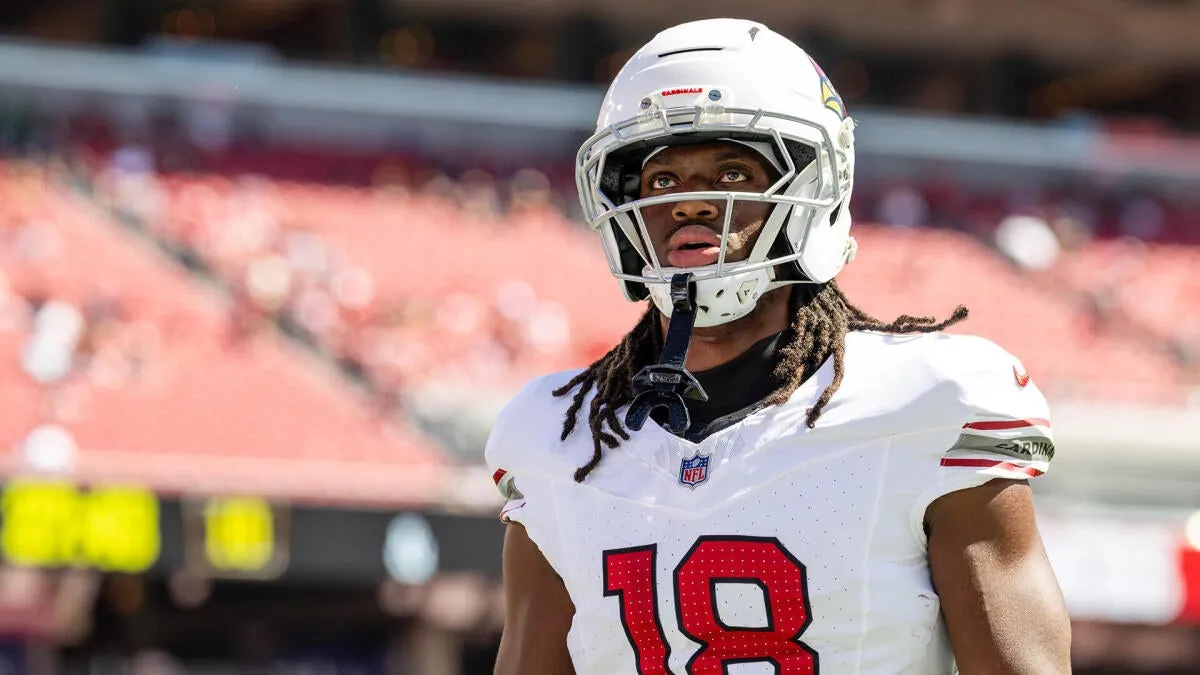
A slow start to the season has raised questions about whether the Arizona Cardinals should trade wide receiver Marvin Harrison Jr., the fourth overall pick in the 2024 draft. A CBS Sports analysis sees potential in a change of teams but notes that similar trades have more often failed to meet expectations.
Harrison had 885 receiving yards in his rookie season, slightly below the 901-yard average for top-10 receivers over the past decade. He had 608 yards in 12 games in 2025 and, through four games this season, has five catches for 85 yards. In his first 33 NFL games, he has 1,578 receiving yards. Amari Cooper had 2,285 at the same point in his career, while Corey Davis had 1,503.
Across his first 33 games, Harrison is below the average for first-round receivers in yards per game, receptions, catch rate, yards per target and yards after the catch. Among 53 receivers in the comparison, he ranks near the bottom in most of those categories. He has some strengths, too. His 13 touchdowns through 33 games exceed Cooper’s and CeeDee Lamb’s totals at that stage, and he ranks ninth in explosive catches per target.
The concern is not only his production but his shrinking role. In the first four games of his third season, Harrison ranks 39th among 41 first-round receivers in receiving yards and is tied for last in receptions. Through his first 29 games, he averaged 51.5 yards and 6.5 targets per game. This season those figures are 21.3 yards and 3.3 targets. His catch rate has fallen from 54.5% to 38.5%, and his targets per route from 20.5% to 9.2%, even as he runs more routes per game.
CBSSports.com’s analysis sees arguments on both sides. Harrison ran 17 go routes in his first two games, and quarterback Jacoby Brissett took some responsibility after a game in which the receiver had no catches. But tight end Trey McBride and receiver Michael Wilson have combined for 58 receptions in four games, compared with five for Harrison. The slump cannot be explained solely by the scheme or quarterback play.
History shows a difference between becoming more productive and becoming a star. Corey Davis, Mike Williams and DeVante Parker improved after modest starts but never became consistently elite receivers. Lamb, by contrast, was already averaging 62.6 yards per game through his first 33 appearances, compared with Harrison’s 47.8. He later became one of the league’s top receivers.
A change of teams can help, but the clearest success stories came after players had already proved themselves. Cooper’s average rose from 46.7 to 80.6 yards per game after Oakland traded him to Dallas in 2018. Brandin Cooks also excelled after moving from New Orleans to New England in 2017 and later to the Los Angeles Rams. Both had already recorded two 1,000-yard seasons before their trades. Other first-round receivers, including Phillip Dorsett, Corey Coleman, Jalen Reagor, Jahan Dotson and N’Keal Harry, did not become the players their new teams had hoped for.
CBSSports.com’s analysis considers a third-round pick closer to Harrison’s likely trade value than a first-rounder, though a team convinced it can unlock his potential might offer a second-round pick. Arizona does not have to move him and could give coach Mike LaFleur the rest of the season to find a better way to use him.
The analysis names the New England Patriots, Kansas City Chiefs and Indianapolis Colts as possible fits. In New England, Harrison could line up behind A.J. Brown. Kansas City may need receiver depth because of injuries to Rashee Rice and Tyquan Thornton. In Indianapolis, Harrison could join Josh Downs and tight end Tyler Warren while Alec Pierce recovers. These are the writer’s suggested landing spots, not reported negotiations.
The writer believes Harrison can play better than he has in Arizona but says consistency remains the key question. A trade could give him a fresh start, yet past examples show that a change of teams often does little for receivers who have not established consistent production.