
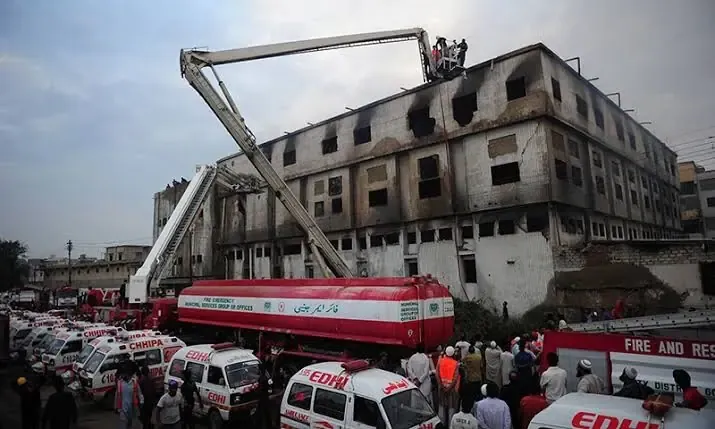
The court refused the provincial government's request to revisit its June 10 ruling that overturned the convictions of two former MQM workers over the 2012 Karachi factory fire.
A three-judge Supreme Court bench also dismissed a separate petition seeking to remove remarks about the Muttahida Qaumi Movement (MQM) from the June decision. A detailed order on Wednesday's proceedings is expected later.
The fire broke out on September 11, 2012, at the Ali Enterprises garment factory in Karachi's Baldia Town. More than 260 workers, including 16 who were never identified, died. Dawn described it as Pakistan's deadliest industrial fire.
In June, the Supreme Court set aside the convictions of Abdul Rehman, also known as Bhola, and Zubair, also known as Chariya. They had been convicted of murder, extortion, arson and terrorism. The court gave them the benefit of the doubt after they challenged death sentences imposed by an anti-terrorism court and upheld by the Sindh High Court.
The Sindh government asked the court to review its June ruling, arguing that it contained errors concerning facts, circumstances and confessional statements and misapplied the law on vicarious liability and common purpose. It said the court had overlooked testimony from key prosecution witnesses, the factory owner and a judicial magistrate, as well as a joint investigation team report.
The Supreme Court's June judgment called the fire one of the most tragic disasters in Pakistan's history. It noted that the original case concerned alleged failures by the factory's owners and management to provide adequate safety measures. About two and a half years later, prosecutors alleged that the factory had been deliberately set on fire after its owners refused to pay 250 million rupees in extortion money allegedly demanded by MQM. The petitioners said they had been made scapegoats to target their political party.
The court stressed that the prosecution must prove guilt beyond reasonable doubt and that assumptions cannot substitute for reliable evidence. Dawn reported that the judges considered testimony from around 400 witnesses weak, hearsay or otherwise unreliable. The court also said alleged crimes by individuals cannot be attributed to an entire community or its political party without tangible and convincing evidence.